Showing posts with label Cthulhu. Show all posts

Sunday, September 27, 2015

Call of Cthulhu Props – the slightly dark art of prop making


Recently on the blog site Propnomicon, a real historical archeological object was brought forth as a possible prop item for playing the role playing game, Call of Cthulhu and this set me thinking.  See the post http://propnomicon.blogspot.com/2015/09/the-curious-case-of-cthulhu-stele.html

With a little work a historical object can be modified into something of fun and interest for your game.  The point is to make something as a gaming aid, not in making a forgery or hoaxing a gullible public.  I decided to make a bit of a tutorial on how to rework a photo over and place it into a gaming context for players.  For that I primarily used Photoshop and some images gathered from the web.  Note that I didn’t try hard to mimic an authentic old dig book, but left the format rather plain so it will fit into a number of eras.

Now that you have your object's image, you need to set into context like a gem into a ring.  An association to reasonably old and obscure publication helps.  It really doesn’t matter if the publication is made up whole cloth, or your drop your page into an existing book.  The point is to make it reasonably believable to your gamers.  A few additional photos for support to add a garnish to your page and you have a passable (for gaming purposes) page to show your players.

But first a little photomanipulation is in order:


 You can use your picture as is, but dropping it into a book just sharpens up the presentation.  Remember context helps suspend disbelief in players.

You can print on different types of paper and add use marks or damage.  You can also turn it slightly brown for aging.  It's up to you to decide how it will look.  A book cover is pretty easy to turn up on line.

This project was done with bare-bones computing resources just to show that it's within anybodies grasp.  All I used was an old laptop computer and a decade plus old copy of Photoshop Elements 2.  Nothing else. That also includes the modification on the photos to make them look like antique formats.  With more sophisticated software and a fairly modern computer, you can really make some believable documents and photos with a good printer.  Oh yes, all of this is done in low resolution 72 dpi because its only was intended to be demonstrated on the web and not really printed out.  I generally work in 350 dpi for projects that are going to be printed or I need photorealistic products.

It’s up to you to decide to how to incorporate this item into your scenario:  they could be questing to find the fragment, which had been stolen; they could be looking for the rest of the fragments to assemble a terrifying realization.  You can print this out, age the paper if you wish and let your players find this clue.  I just quickly knocked this out with no real attempt to make it pass muster as original, but you can take your time using the same techniques and produce a highly believable prop.  Halftoning it would make it look like an autogravure, typical in old dig books.  I didn’t add any incriminating dates so the page can be used for the 20s & 30s or be a much older book that is referenced the players.

Note that I added the insinuation into the text that one figure was using a control panel, with a joystick no less.  Maybe it’s a late Dynastic version of an Atari game.  Erich von Däniken
would have loved it. You can also add other pages with modified or even original photos to add depth to your presentation.


Yep, it's an original unaltered photo, but it works well for the story.
A fairly modern photo made to look older.  Do you know the source?
Another real photo, unmanipulated -- hard to tell, isn't it?
So now you have a little inspiration to go forth and spice up your CoC campaigns.  Photos are much easier than other physical props and if you take a photo of your prop, drop it into prop book or make manipulated pictures, you can really add a dynamic to your game with a multi-level prop.  Because you can add your own text to the book like I did above, you can tell the story your way.  It's all pretty basic really. 

No Egyptologists were injured in the making of this paper prop.

                           CoastConFan

Background and links
Here is the original location of the fragment on the web, torn from reality and set down in H. P. Lovecraft’s Cthulhu Mythos setting of the 1920s-1930s.

Another blog entry of mine about using original items as props, in this case Jomon Culture items embedded into the Lovecraft Cthulhu Mythos  http://coastconfan.blogspot.com/2015_06_01_archive.html 
I was tempted to use the location of Tanis in this prop project but considering my previous post on the subject, decided to go for a more obscure site   http://coastconfan.blogspot.com/2014/09/ancient-tanis-forgotten-occasionally.html

 
Does this fine antique image of a dig from the 1880's look familiar? It should, its source if from Raiders of the Lost Ark, modified into an ambrotype photo, damage and all.  But you can use such items as support for your prop, be it paper or some other material.  BTW the other antique dig photo above this one is also another Raiders image, but made to look 1920s.

Thursday, September 18, 2014

Michael Moses Pottery and the Lovecraft Cthulhu Box


The stars are right!  Here’s a ceramic piece that mixes Georgian era mourning themes, H. P. Lovecraft, and Chinese styles in an eclectic production worthy of its own inclusion in Weird Tales. 
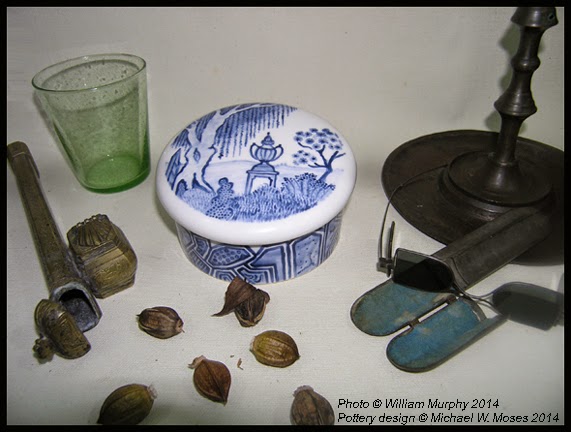
An old friend of my mine, Michael W. Moses the art ceramicist had just gotten a new piece of ceramic out of the kiln the other day.  He allowed me to photograph it in a little tableau that sets off its complex mood and little surprises quite nicely.   The body of the box is just over four inches at its widest and varies from just over one and a half inch deep to over two and a half inches deep.  The lid is five and a quarter inches wide and under an inch deep.  Now that we have the preliminaries out of the way, let’s get to the fun.
This offering is a cylindrical lidded box with an asymmetric cant to the rim so it’s not a perfect cylinder, but bent slightly.  It’s painted in a type of blue-and-white ware that is evocative of 17th and 18th century Chinese export ware as well as period Continental imitators (such as Delftware) of this type of ceramic.  The box has been meticulously hand-painted all over and I mean on every surface!  The style is not in the typical heavy, solid blue, but in a softer watercolor style, which is semi opaque due to the underglaze paint being applied directly to the bisque body in delicate layers. 

The top of the lid features a classic, misty Georgian mourning scene with the iconic urn and weeping willow, but it is perked up with a little Japanese pine tree in the right.  Notice also on the far left, in place of the typical obelisk, there is a strange stone menhir beside willow.  Setting off the vignette there is a wide border of white nothingness that frames the image – again very Japanese with the effective use of white space.

The outside of the box is an interpretation of a cyclopedian wall, which could well be from Machu Picchu or R’lyeh.  Actually, the wall could also be in the mood of an abstract Japanese or fabric ceramic pattern as well.  This wall echoes the Georgina themes as the wall around the graveyard, yet is much more ancient.  If you look closely at the wall, you will see curious little things on it:  creatures, mazes, and even scenes of other places or times. 

When you open this box you find a bit of a surprise inside because it has a fully illustrated interior.  The inside wall of the box has a lot of curious plants growing around it.  Is it undersea life?  Is it alien plants from another planet or are they actually animals like corals or crinoids?  I do know that each plant unique, individual and there are about 40 of them.  We’ll probably never know their origin or names.  Notice how the plants fade in an out slightly as if they were underwater or showing through another dimension or in a slight fog from a moor.  The bottom of the interior has a polyhedral tile set into the floor with a very long inscription in an unknown language; it’s not even possible to determine the orientation of the text.
Do you think that’s the end of the surprises?  Nope, flip the lid over and get a view of H. P. Lovecraft’s creation, Cthulhu (Cthulhu Pantocrator? Phagiomundi?) with yellow eyes (the only other color on the whole piece).   You see that that Dread Cthulhu, surrounded by impressionist stars,[1] and is peering at you from what might be the porthole of a ship, from the bottom of a well, or from the viewer of a Tillinghast Resonator[2].  Note that the rim of the inside lip has a jaunty dash decoration. 
OK, one more bit hidden joy is found on the bottom of the work.  Along with Michael W. Moses’ inscription and signature, is a pretty unknown type of winged arachnid within a border, it may be cryptozoological, but it probably isn’t poisonous or going to lay eggs inside you, probably.  Note that the roundel is glazed but the rest of the bottom of the box is bisque, which gives a different texture.   

Mr. Moses has layered on historical styles, periods and interpretations all on one box.  Each design is original, unique, and hand-painted.  It is not transfer ware or machine made.  This is part of his second line of pottery where he uses a commercial blank rather than the typical hand-built body you see in his works.  He says the great thing about pottery and ceramics is that they can survive for thousands of years, unless a glacier in the next ice age grinds it up.

Michael started making blue willow type porcelain about 30 years ago and it has resurfaced in his work again in his new series of Delft-like wares.  Unlike Delftware, this ceramic is no base coat of white tin glaze, instead the bisque body is already snowy white.  The blue is painted directly onto the bisque using an underglaze paint and then a clear overglaze is applied over the whole.  The whole thing is fired to cone 7 or so. 
This art design is copyright Michael W. Moses 2014.  Go to his blog to see this work in progress before the final firing.  You might be surprised that the false colors end up blue and the green as clear.  Each piece of his work is individually serial numbered, but note that when I got there and photographed the piece before the serial number was written.  For that matter, he hadn’t even finalized the name of the piece yet.
After I took the initial photos, I got playing around with the Cthulhu Box and put together some tableaus to show off what a good decorator it would make.  I added in a few props such as a candlestick from the late 1600s, a brass late Ottoman pen & ink set, a pair of 1840 double lens “D” sunglasses and case, some Star Hibiscus seed pods (because they looked interesting) and the interesting water glass is actually just a modern green bubble glass.  I didn’t realize that the picture would be a little distorted, but in the end, but I can always claim I meant for that effect.

Another blue and white work
So if you need a stealth creepy piece of art for your study, beside table, boudoir, or just a collector of art, this box should fill the bill.  It’s a unique hand-painted work inspired by a mélange of historical ideas and artistic styles.  Michael W. Moses’ pottery can be seen on Etsy, and his blog on line.  All you have to do is Google “Michael Moses Pottery” to get a large number of image hits.  You’ll enjoy his cryptozoological plant/animals and other works of his fertile mind. 
                                                                      CoastConFan
Footnotes
  [1] The Tillinghast Resonator is a lab device from the H. P. Lovecraft story, From Beyond, pub. 1934, which allows the unseen world to be revealed.  Read the story here:  http://www.hplovecraft.com/writings/texts/fiction/fb.aspx
  [2] The star background behind Cthulhu really puts me in mind of Van Gogh’s painting, The Starry Night, https://en.wikipedia.org/wiki/The_Starry_Night

Links of interest
Michael Moses’ blog article featuring this piece:
Another Michael Moses piece, featured on Propnomicon back in 2011:  http://propnomicon.blogspot.com/2011/01/cthulhu-fhtagn-moses-edition.html
Plant symbology was important in mourning iconography:  http://artofmourning.com/2006/01/17/symbolism-meaning-plants/

For those of you who made it this far, a little movie:

Sunday, December 9, 2012

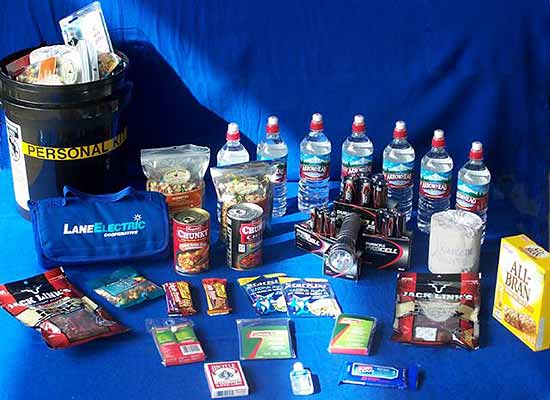
Apocalypse Kits – It’s Not Just About Zombies, Maya, and Alien Attacks

Avoid being a post-disaster casualty by being a little prepared and having some common sense.

 I follow a practical blog called The 72 Hour Kit, which was created under the concept that in the case of a natural disaster and the like, that it would take about 72 hours for emergency help to arrive and that you must be self-sufficient for that time.  He went further to create not only home kits, but car kits and personal walk-around kits for urban travel, hiking and the like.  It’s all very practical and levelheaded.  Most of these kit contents are common items available everywhere and might be necessary for immediate survival up to 72 hours.  This isn’t hard-core survivalist junk, it’s just common sense.

UPDATE August 2014 -- The blog I mentioned above, The 72 Hour Kit, hasn't posted in two years, so it's a bad sign that the zombies got him after all.  But take cheer, there are many more practical preparedness sites out there. 

 Along that line and with all the babbling about imminent zombie apocalypse, Mayan apocalypse, nature rebelling, tidal waves, Planet X striking our Earth, and the like has gotten me thinking a bit.  Mind you, I survived Hurricane Camille, Hurricane Katrina along with a number of smaller hurricanes over the years.  I have also gotten to enjoy a wild fire, sand storms, earth quakes and 20 years in the military as well as a few urban riots and the like, but at least learned a bit along the way.  Needless to say, I do have stuff set aside for expected emergencies such as hurricanes, extended power outages, Cthulhu rising from the sea, and that sort of stuff.  Anybody living along the Gulf Coast with any sense has evacuation routs set up, extra food and water during hurricane season as well as tools and repair materials for a month or two of living in difficult situations.  Been there done that.
 Now on to fun-filled fantasy.  Back in the mid 1970s we did a lot of role playing games and set up some that were vaguely reality based.  For example we started a campaign with only the items that you personally own.  Let’s say a crank professor friend from the university of ours has a time travel machine and wants us to go back for a few minutes into the past.  Well you take a few goodies for maybe a day’s lark back into time and guess what … you don’t get picked up.  Uh, oh, and all you have is the junk in your back pack.  Honesty here is important for game play to make sure that the players would actually have all the stuff that they would put in their back pack, which would be their emergency kit.  Hey, all you brought was a case of Twinkies and a stuffed bear?  

 Along with that scenario was a zombie scenario based in our own town.  To narrow it down, everybody made it to the closed mall and hope they locked out all the zombies, maybe.  In any case, we used the local mall, which we were all familiar with as the source of what might be found.  The fun part was that everybody knew exactly what was in the food court, in the Sears hardware department and the like, so there was no need to dig up a supplement.  We had lots of fun potting zombies there in the mall in the 1970s.  It was a simple game to set up and the context was one that everybody got. You guessed it, we used the paradigm of Dawn of the Dead (1978) as out lead-in.  We got started in no time and had a great few evenings role playing, while using local terrain and the local mall for a background.  Next time you need a cheap, fast, and easy scenario, just pull that one out folks!  You could narrow the scope down a bit and just do a single house in Night of the Living Dead (1968) style, but if you are going to have a zombie apocalypse, have a big one! 

Anyway, seriously folks, catastrophe can happen in an instant from a 30 car pile up, to a toxic spill from a truck or train, to a power plant going up, not to mention tsunami, ice storms, hurricanes and the like.  Try to have your self together a little at least.  In all the cases where I was in a major hurricane or earthquake, etc, everybody pulled together and strangers helped strangers.  But you just can’t sit back and expect everybody else to help you, try to do a little yourself.

For those of you interested in zombies, can view my earlier blog entry called The Logical Zombie.
                                                                   CoastConFan
Additional useful links:


-------------------------------------
UPDATE 14 DECEMBER 2012 -- Today NASA was so sure that the world wouldn't end that they released a new video on YouTube today (seven days before) called "Sciencecasts, Why the World Didn't End Yesterday", scheduled the day after the so called "Mayan Apocalypse".  NASA didn't explain why there was an early release, maybe they wanted to put in their two cents before it all ended.  Anyway, click on the link to see a rather limp video with mediocre computer generated narration voice (so bad it had to have subtitles) -- give me H.A.L. anytime. 


Just put on your tinfoil hat and hope for the best.
                                                                                                  CoastConFan

Monday, October 22, 2012

TREPAN, or How I Learned to Stop Worrying and Love the Insanity


Trepanation has always held a fascination as a medical oddity practice since the dawn of time.  Very early man practiced cutting holes in the skulls of “patients” and some of them survived to go back and have several more holes cut.

The exact reason why trepanation began in great antiquity is not known.  Anthropologists theorize it may have been shamanistic as much as medical.  Opening the skulls may have let evil sprits out, which may have been manifested as headaches, or perceived demonic possession, perhaps mental illness.  The point is that it must have been survivable and worked in some cases for it to be added to the list of medical/witch doctor treatments.

Trepanation continued to be practiced well out of the Paleolithic and into the Neolithic era and on into the Bronze Age, up to the present time.  The reasons may have changed, but the basic techniques have not:  you cut a hole in a person’s skull to gain a benefit for the patient.  Whether it is medical, spiritual, shamanistic or psychic, the practice continues to this day.


The original tools were sharp stone tools such as flint or obsidian cutters.  Anesthesia didn’t exist until the middle 19th century so trepanation was just one operation among others, such as amputation, that had to be done while the patient was able to feel pain.  The tools evolved from stone to bronze to iron to surgical steel and the forms of the tools took on a specific look for the very specific task of head boring.  Elaborate trepanation tools in cases were available to surgeons and many sets still exist and are collected today.

Outside of the shamanistic reasons for cutting holes in people’s heads, there are very real reasons for modern surgeons to perform this operation, such as preparation for brain surgery, relief of pressure and the like.  The present term for such an operation is craniotomy rather than the old-fashioned trepanation with its negative connotations.


There still continues to be a folk medicine movement involving trepanation for psychic or pseudo-science reasons.  I was rather surprised to find that there is a strong movement for non-medical trepanation and even for self-trepanation.  


All of you folks who enjoy an occasional horror movie or play the H. P. Lovecraft inspired role playing game, Call of Cthulhu, might find the information and links of some use in the Arkham Sanitarium.  For those few of you who are contemplating trepanation at home for fun and profit, keep up your medical insurance payments, you’ll need it.
                                                                                                CoastConFan


The bottom line is:  Kids, don’t try this at home!


ADDITIONAL LINKS


Tuesday, June 26, 2012

TINTIN COVERS 2 – The Lovecraft Connection


Previously, I posted Tintin Covers 1 – The Realty, about the sale of original Hergé artwork in Paris.  Now I want to show you some fan-made covers that are strictly non-canon.  I have been a fan of H. P. Lovecraft since I was young, although not as long as having been a TinTin fan.  But my enjoyment of both goes way back, nonetheless.

Fans have produced their own covers for nonexistent books, supposing a Lovecraft – Hergé connection that never was.  Fan art is a mainstay of fandom and no less than in Tintin and Lovecraft fandom, so mashups were inevitable.


These covers don’t undermine either genre, but rather show support for existing works.  Enjoy these covers in the playful spirit they were created.  It’s a pity that the complete books never really existed, but it’s nice to think they might in a parallel universe. 


We no long have H. P. Lovecraft or Hergé producing stories, but their corpus of works have been influential for a good portion of the 20th century and into the 21st.  I hope that in presenting these fan-made covers that people will be influenced to read the original works of both H. P. Lovecraft and Georges Remi a.k.a. Hergé.
 

One of the most prolific of the fan Tintin/Lovecraft mashup artists is Muzski, who is actually Murray Groat.  You can see more of his works at DeviantArt.
 

This post is a follow up to the one I made previously about the same subject, Lovecraft Tintin Books – Two Great Tastes That Taste Great Together, February 25, 2011, and I felt there was so much good material out there, that I had to expand on the idea.
 

TINTIN COVERS 1 – The Reality

TINTIN COVERS 2 – The Lovecraft Connection

TINTIN COVERS 3 – Weird Science  

TINTIN COVERS 4 – Politics, Parody, Pastiches, and Irony 

TINTIN COVERS 5 --  GREAT SNAKES!  MORE TINTIN COVERS  

I had to post this Peanuts/Lovecraft cover, although it is dangerously close to Cutethulu.  I always thought there was something eldritch about the Great Pumpkin. 


UPDATE 2014:  a few more Tintin Cthonian covers below for you to ponder: