Showing posts with label WWI. Show all posts

Tuesday, May 2, 2017

Mr. Pratt’s Gun Hat or How to Be Fashionable But Deadly in the Trenches


Albert Bacon Pratt of Lyndon, Vermont patented a hat and a gun, but the interesting thing is that they were designed to be used together.  The patent for the hat was US 1,183492 A and the patent for the gun itself was US 1,323609 A. The patent office took a little longer in approving the gun than the hat for some reason.
In that mythical period before the internet, I stumbled on an interesting book called, Firearms Curiosa [1] and found an item on page 260 that looked like a joke or something out of a Monty Python Victorian cut-up animation.  It was Albert Bacon Pratt’s hat helmet with a patent drawing of the bespiked chapeau sporting a gun barrel above the visor.

My original copy of the book was lost during the storm (Hurricane Katrina) and a few years later I required another copy for some research on a belt buckle pistol that I had previously seen in its pages, but that’s another story.  After I turned up the information I was originally seeking in Firearms Curiosa, I reacquainted myself with the peculiar weapons depicted and saw familiar image; dear Mr. Pratt’s Hat Gun.  Since it handily had the patent number.  I could look up that patent online and read in full the details of this amusing head cover.  Thank you, Mr. Winant for your thoroughness in writing a most interesting book sixty years ago.

With a bit of research not only did I turn up the original patent drawings of the hat gun and the legal description of the intricacies and eccentricities of the hat, but equally exciting, I found the patent for the automatic pistol itself, which sat inside the armored hat.  With a bit more poking around, I found that Mr. Pratt also patented a few other objects as well as a handy sliding stock for rifles.  It’s the only thing he patented that was practical and still usable today.  The M16/AR15 collapsing stock is pretty much along the same concept as his, although it was only adopted by the military a half century or more afterward.[2]  The rest of the stuff ranged from amusing to impractical, as with most patents. 
But let’s get back to that hat.  The forms for patenting Mr. Pratt’s Wonderful Hat were filed on 14 July 1915, which was before America itself got involved in The War to End All Wars and it was eventually approved by the US Patent Office on 16 May 1916.  America went to war thanks to Congress’ declaration, 6 April 1917, armed with a number of useful patents and inventions, but Mr. Pratt’s Wonderful Hat is not among them.[3]

The hat is both a sun helmet as well as an armored gun port with a fixed handgun-sized semiautomatic pistol ensconced in the crown.  What appears to be a cannon barrel protruding in the hat in the illustration is in fact a semi shroud over the gun barrel itself.  The bottom portion of the barrel shroud is open.  The handy hat also has a generous bill fore and aft, which is not a bad thing in itself, shedding sun and rain.  The chinstrap is a pretty conventional set of buckled armored scales often seen on metal cavalry helmets of the 19th century.  A secure chin strap also necessary when firing the gun to keep the hat from flying backwards off the head.
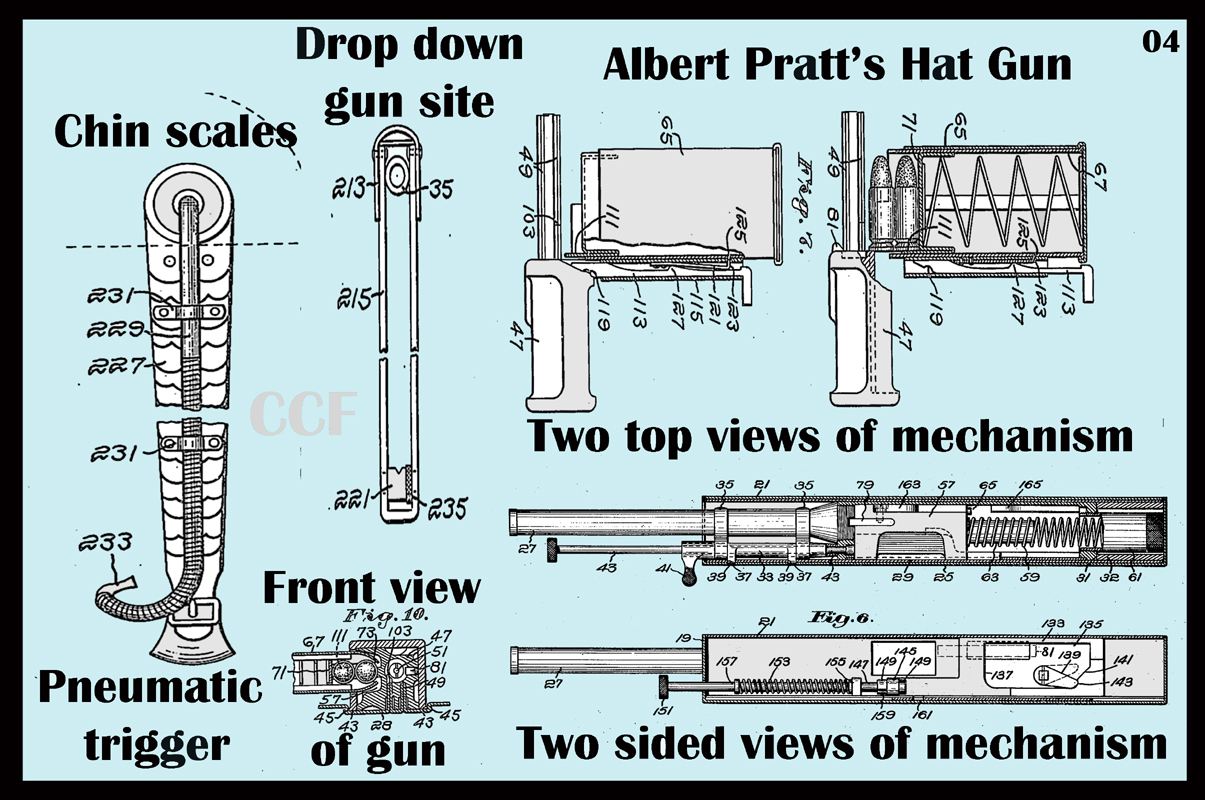
Alongside the left chin scales is the trigger for the gun.  It a pneumatic tube, which can fire the gun with a simple puff of air. The pneumatic trigger to fire the gun was activated by blowing into a rubber tube possibly takes some inspiration from the pneumatic squeeze bulbs used to operate cameras, if so it’s on solid historical ground.  This allows the gun to be fired hands-free, which is a salient point in the patent text.  Aiming the hat gun is performed by simply turning the head and looking at the target.  For pinpoint accuracy a flip down sight is included which is housed inside the barrel shroud when not needed.  Who could ask for more convenience a century ago?  Before weapons computers, there was the brain!  You need only look, puff and fire.  The auto pistol loads a new round into the chamber and you are ready for action.

Pratt also patented the special gun that resides in the hat.  It’s basically an automatic pistol with a lateral magazine.  I’m not sure what happens to the hot brass extracted from the gun, but I hope it doesn’t fall down the collar of the intrepid hatketeer (musketeer) as he might be christened.  That clever gun is has patent number US 1323609 A, filed on 15 May 1916 but not granted until 2 Dec 1919, well after the war was over.  Ah well, it’s our loss.

The gun can be quickly charged by pressing a rod just beneath the barrel and easily accessible to the shooter’s finger since the shroud does not enclose the bottom of the barrel.  With practice cocking the gun can be accomplished with ease.  The gun’s safety is as simple as just tucking the pneumatic tube up into the helmet out of the way of errant sneezes.  The gun takes box magazines, which can be exchanged by doffing the hat, opening the top and quickly inserting a fresh magazine.  It appears that the gun might use a standard caliber, such as .32 automatic or possibly 9mm Kurtz, as the patent does not specify a preferred loading.  Certainly nothing larger than those would function well in a gun perched on the top of the head.  Of interest is the fact that the forward bill of the hat functions also as a blast shield from the gun’s discharge.  It’s a useful point. 

The gun can be removed from its bed on the lower section for cleaning or service quickly by rotating a toggle that lies quite near the charging handle.  I don’t think the gun was ever tried out nor has a patent model ever surfaced.  It’s a shame, because the thing would make an amusing Youtube video. 

The top of the hat functions as an armored helmet, which was just beginning to coming into vogue in the trenches of WWI due to shrapnel injuries.  The top of the hat can be removed by pressing spring held latches, which release that section.   The upper metal portion also has the handy feature of being used as a cooking pot as per the patent description.  The handy spike can be struck into the ground to hold the pan above a fire and the barrel shroud makes a handle.  The gun mechanism itself would be left behind and would remain in the bottom half of the hat and did not partake of the stew.  In fact, in a cooking emergency, the bottom of the hat, with the gun could remain on the head and fired at an enemy without interrupting your cooking!

Back to that fancy spike on top of the hat, which is type that graced the famous pickelhaubes of the Germans for decades.  But keep in mind that Teutonic spike also had appeared on the apex of American military hats as well.[4]  In fact the shape of Mr. Pratt’s hat is fairly close in outline to British military pith helmets such as the Bengal Lancer pattern, which on occasion could sport a spike as well.  You might take a look at my previous post on pith helmets if you have an interest on their history.  http://coastconfan.blogspot.com/2012/06/pith-helmets-sun-helmets-and-sola.html 

In considering Mr. Pratt’s Gun Hat, I don’t think much of having an army of hat gunners who point their weapons at the person they are looking at.  Imagine in formation: “Fall in, dress right dress, atten-shun .. eh .. eyes right, no sneezing in the ranks”!  Yes it could get quite dicey in some situations.  I think I’ll leave the hat gun for another war and another time.  Although they might have been useful for a bicycle corps, which at one time had a vogue among the military, especially in Europe. 

I hope you enjoyed this article as much as I had reading and researching about Mr. Pratt’s Hat Gun.  I added some cleaned up and modified patent drawings to illustrate some of the operating points of the hat and the gun.  Hopefully it should be clear up any questions the reader may have. If you know if there was a patent model produced or you know where the model is located, let me know and I’ll add that information to the blog entry. 

                   CoastConFan

Footnotes
  [1] The hat gun is mentioned in Firearms Curiosa, 1955, page 260, by Lewis Winant, published by Bonanza Books, NY.  The book is still reasonably priced from used book dealers. 

  [2] Patent number US 1191460 A   

  [3] Also not among them was the Wright Brother’s patent for safely controlling aircraft with ailerons.  The government didn’t want to pay them anything, so war-bound US aircraft were shipped up to Canada and the US patented bits were added there, prior to shipment to the front.  Military authorities also were not much interested in the Lewis Gun (due to politics), which was invented by US Army Colonel Isaac Newton Lewis in 1911, based on previous work by Samuel Maclean.  But the Brits loved it and it became one of the practical first man-portable machine guns.  It was used from WWI through WWII and years beyond.  The US did make a few on their own, but seemed largely disinterested after the Browning Automatic Rifle came out. 

  [4] American sun helmet Models 1880/1887/1889 and the 1902 sun helmet most of which had optional spike   http://www.nyc-techwriters.com/militaria/american_helmets1.htm

Links of Interest 
25th Infantry Bicycle Corps was an African-American military unit at the end of the Victorian era.  http://www.historynet.com/us-armys-25th-infantry-bicycle-corps-wheels-of-war.htm


The Wright Brother’s aircraft patent problems https://en.wikipedia.org/wiki/Wright_brothers_patent_war


Monday, July 28, 2014

Centenary of WWI – But Not Many Lessons Learned


This first of August 2014 is the centennial of the start of the Great War.  

 The road to The War to End All Wars was a long one and although not compeletly inevitable, but became more certain as the military and political lines hardened.  I am going to take a different track in looking at this misunderstood conflict and use the perspective of the timetable, (which is how the general staffs of the belligerents looked at it) and less at the classic timeline and battle approach.  But a timeline is also important to get the facts in their correct order. 

As every school child knows, the assassination of Archduke Francis Ferdinand by a terrorist group on 28 June 1914, one month before the start of the war, (see the July Crisis) began the final (and probably inevitable) sequence leading to a world war.  The Austro-Hungarian Empire declared war on little Serbia and the whole series of patched-up relations and entangling treaties between European powers began to unravel.   I won’t go deeply into the causes, because it’s pretty involved, but I am sure that the TV entertainment powers will jump onto bandwagon and we’ll have endless rehashes and revisions and finger pointing, all with commercial interruption galore.  One thing I will talk about is timing, but more on that a bit later. 
The regional war that started in the Balkans on the 28th of July 1914 became a world war by the 1st of August, when some of the world powers declared war on each other.  Note the world war starts when the big power war declarations fall on and just after 1 August.   America manages to hold off from joining in the war until 6 April 1917. 

On a personal note, for those of us folks who can remember the centennial of the Civil War, the bicentennial of the American Revolution, the Centennial of WWI is a sobering thought if nothing else, due to the passage of time and how few lessons have been learned.  Years back I had met a small number of WWI vets from different of countries and they are all gone now.  It’s made me to reflect and I have to wonder about what the world will look like by the time of the Centennial of the Gulf War.  If I don’t miss my bet, it won’t look any better and people won’t be any smarter.  See also, “A rich man’s war and a poor man’s fight” with the coda that “the rich get richer”.  Sounds kind of jaded, doesn’t it, but it rings true regardless of your political affiliations. 

OK, back to timing.  One thing that most modern people fail to realize in this age of large standing armies, is that previously, a military mobilization was generally felt to be an act of war.  Mobilization was a key part of warfare in a time of small standing armies.  Europe, while keeping small but professional armies, had wide-spread conscription and a complex and in-depth system of reservists and national service.  In the US the system was a bit different.  They augmented their very small standing army with state militias (later national guard units) along side conscription of raw recruits.  In this way, countries could have both a large and small army at the same time.  In times of national emergency, you mobilized your reservists, who then went to their local depots, drew their war fighting gear and then under a war plan, were either set in a defensive stance or as a combat reserve in pre selected locations or went to marshalling areas to be sent on the offensive and meet the enemy in battle.

Here’s how the dominoes fall:  On 28 July, the Austro-Hungarian Empire declares war on Serbia (Russian ally) and the Russians begin mobilization on 1 August, the French order a general mobilization, and the Germans mobilize also on 1 August.  The world war has started.  The actual declarations of war follow swiftly with Germany declaring war on Russia (and its allies by way of interlocking treaties), on 4 August the UK officially declares war on Germany (and its allies), and France declares war on Germany somewhat belatedly on 11 August.  Note that it is the mobilizations that start the war and the declarations are somewhat beside the point. 

So you see how this works?  It’s like launching missiles in this day and age, they may be armed or they may not, they may have nukes and they might be filled with flowers.  You launch we launch.  You mobilize, we mobilize.  Guess what, a war has just broken out.  To follow the analogy, a country calling a mobilization in 1914 equals launching rockets in the Cold War or today.    In the next few days in the summer of 1914, things get uglier as the great powers unlimber for war and declarations fly fast and furious and it all goes downhill from there.   https://en.wikipedia.org/wiki/Timeline_of_World_War_I

As a quick aside, one myth about WWI is that it was a war completely tied up in trench warfare.  The truth of the matter is that it was only the portion of the world war, located in Western Europe that eventually devolved into defensive trench warfare. The war in Eastern European theater was one of classic maneuver as was the war in the Middle East, Asia, and Africa.  It’s a world war remember, not the war of Western Europe. 

Let's return to the timetable.  The clock was ticking for a war by the fall of 1914:  Military theorists of the time held that seizing the offensive was extremely important. Timetables were paramount and starting your war by the end of the fall harvest had been part of war ever since there were agricultural civilizations.  This theory encouraged  belligerents to start their was as early as possible after harvest and strike first to gain the advantage.  If you mobilize when the harvest is over, releasing your agricultural workers to fight, who at this time are over half the population, you then have at least 150 days of decent weather to fight.  Once you get northern European snows, wars bog down and movement is pretty much over in this period, so you have a limited time to get your work done, mobilize and fight your war before winter sets in.  If you get caught, then you have to wait for the spring thaw and the inevitable mud bogging your down your spring offensive.  So the fall timetable works best if you want a quick war.  See how the timetable works?  The ultimate application would be the blitzkrieg (a later term, but quite succinct), whose roots were in the Franco Prussian War, was the prime ideal for rapid employment and a quick war, but not drawn into full fruition until WWII by the Germans.  Practice makes perfect.

So if you could field your army first while the other countries were still trying to muster, you would have the field and the initiative.  If the other guy fails miserably in mustering their army, they probably will lose or at the very least, be dangerously on the defensive as they flounder.  The French found that out in the Franco Prussian War.  To misquote Confederate General Forrest of American Civil War fame, you will “Git there fustest with the mostest”.* 


The actual conduct of the battles in the World War is not within the purview of this brief blog post so I’ll fast-forward a few years and a few million casualties later to 1918.  After years of fighting and with casualties in the millions, the fatigued belligerents signed an armistice on 11 Nov 1918 at 11 a.m., the famed 11, 11, 11.  It put the war on hold, stopped the fighting, but did not actually end the state of war.  That happened on 28 June 1919, when the Treaty of Versailles was hammered out.  But military actions continued, such as on the Russian front with an allied invasion of the Bolshevik held portions of Russia, but that’s another story for another time.  There was plenty of unfinished business and lots of new bad business created by the Treaty of Versailles.

The general reaction once the war was over, was to try forget as much as possible for some, to marginalize the event for others, and a movement towards pacificism (and even pacifism)+ and isolation for the US.  Victorious allies heaped indemnities upon Germany through the Treaty of Versailles, which also dismantled the Austro-Hungarian and Ottoman Empires and carved up Asian, African, Pacific, and Middle Eastern colonies of the losing side for the victor’s own benefit.  In general setting up the world for more problems in the following decades, not the least of which was another world war.

Here are some “didja knows” for your next cocktail party’s awkward moment:  Italy and Japan were on the side of the Allies in WWI, with Japan declaring war on 23 August 1914.  The Dutch were neutral.  Mexico was supposed to be neutral, but that didn’t stop them from being part of casus belli for getting the USA into the war, see also the Zimmerman Telegram.  Brazil declared war on Germany on 28 October 1917.  China declared war on Germany 17 October 1917 – it might be of note that Germany had colonies in China, something previously noted by Japan, who wanted Port Arthur and other German areas.  They ended up with a number of German owned Pacific islands as war booty.  See my previous post about early Japanese aircraft.  That those factoids should get you disinvited to the next soiree.   

For those of you who come to my blog for reasons other than an interest in history, e.g. H. P. Lovecraft’s Cthulhu Mythos and movies, there is indeed some link to this post and horror writings (other than the obvious).  In a previous post I wrote about Arthur Machen Angels of Mons becoming folklore and in a post about author William Hope Hodgson, that was killed in WWI, who was a major influence on the writings of  H. P. Lovecraft.  Further you might check out the movie horror series Hellraiser and the origin of Pinhead, Capt Elliot Spencer, who turns out to be a disillusioned WWI vet in his own private hell.  Along with rank and file, WWI ate up company grade officers at a phenomenal rate as they were expected to lead their men personally.  If kings, dictators, generals, and presidents were obligated to lead charges, there might be less wars. 

WWI even had literary repercussions in such innocuous works as Herge’s Tintin books in the person of war profiteer and all around badguy, Bazil Zarahoff, AKA Basil Bazarov in the Tintin adventure, The Broken Ear.  Herge even drew the fictitious Bazarov exactly as Zarahoff to make the point clearly.  Another pop culture post WWI reference to war profiteering was in the person of  Little Orphan Annie’s adopted father, Sir Oliver “Daddy” Warbucks, a steel industrialist.  Sadly, despite eventually inheriting a fortune, Annie never got eyeballs.^

In ending, I hope that some of you out there, up-time from us won’t be observing the Centennial of a future WWIII.  If you are, swill your grog from the skull cups made from your enemies and enjoy the Dark Ages, if the lord of the castle allows.
                                                                                   CoastConFan
Coda
If you are actually interested, but don’t know much about WWI – read a book or two, there are quite a number of good ones around.  I don’t mean that facetiously because this is far too complex and involved for a short treatment on television or on a blog. If the subject is too big to eat whole (and it is), take it a bite at a time, starting with what you think you know and try to expand your knowledge base from there.  Good reading to you.

Footnotes
*This misquote first appeared in the New York Tribune (a Northern publication, mind you) “written to provide colorful comments in reaction to European interest in Civil War generals” (no date to the NYT article provided) from a Wikipedia article about Gen Forrest.  I would appreciate somebody finding the date of the NYT misquote, if they would and possibly a scan. 

^She died Sunday 13 June 2010 at the age of 97, unrepentant and in the hands of a Guatemalan kidnapper. 

+For the distinction  between the two, see this article  http://www.academia.edu/1095087/On_the_Distinction_between_Pacifism_and_Pacificism


Links of interest:
Newspapers of the era:  declarations of war 

WWI timeline of causes

Detailed timeline for WWI 

On the lighter side, a blog post about Turkish delight, WWI and the Crimean War
http://coastconfan.blogspot.com/2011/06/war-turkish-delight-and-witch.html


A Quotable quote not used in this blog article:
“Violence” came the retort, “is the last refuge of the incompetent.”  Isaac Asimov, from The Encyclopedists as originally published in Astounding magazine in May of 1942.  The story was published as a whole as the novel, Foundation the first of the Foundation Trilogy in 195.  The quote was just too good not to use somewhere.


"But what good came of it at last?"
    Quoth little Peterkin.
"Why that I cannot tell," said he,
    "But 'twas a famous victory."

From Robert Southey’s poem, 
After Blenheim

Friday, November 9, 2012

Military Folding Bicycles and Curiosities


Historical cycles for Neo-Victorian Steampunk Revivalists and historians of the industrial revolution.

I have always like the history of early military bicycles, which for me started years back with reading an article about the U.S. Army’s flirtation with military bicycles and also with a series of pre WWI Dutch photogravures I purchased of a machine gun unit that used bicycles to transport and deploy their weapon.   Add to that an interest in inventions such as the folding bike and we’re off to the races.  There is no point in me “reinventing the wheel” so to speak, so I’ve decided to just post some of the photos and links I have found for others who share an interest in military history, invention, and bicycles. 

For an excellent overview of Victorian military bicycling costume, which is perfect for you military minded steampunkers, click the following link.  http://debyclark.blogspot.com/2012/10/victorian-military-bicycle-uniforms.html

Foldingcyclist.com has some excellent information including an amazing folding penny farthing along with a lot of good period illustrations of other early folding bikes and is perhaps one of the clearest and best sites on the subject in a single post.  http://www.foldingcyclist.com/folding-bike-history.html

Don’t forget to check out the BSA & military bicycle museum site, which as a page about military folders.  I really recommend it.  http://bsamuseum.wordpress.com/page-5/

There are a couple of books that I keep seeing referenced, The Bicycle in Wartime: An Illustrated History by Jim Fitzpatrick and It's in the bag: A History of Portable Cycles in the UK, by Tony Hadland; I haven’t read them, but pass the titles along for others to read. 

Wikipedia has the inevitable article  http://en.wikipedia.org/wiki/Folding_bicycle
Also try the online bicycle museum site  http://www.oldbike.eu/museum/
 Here is an article about the previously mentioned U.S. Army bicycle tests.  I didn’t mention previously that it was performed by Buffalo Soldiers.  http://www.intriguing-history.com/army-cyclist-corps-cap-badge/  And an article about the 25th Infantry Bicycle Corps and their coast-to-coast journey to prove the bicycle was an asset to military movement and logistics.  http://www.fortmissoulamuseum.org/blackbicyclecorps.php  and http://www.historynet.com/us-armys-25th-infantry-bicycle-corps-wheels-of-war.htm
 An interesting sidelight on the subject of inventions is this chainless shaft drive bicycle that seems to offer possibilities for fresh innovation. http://www.dynamicbicycles.com/?gclid=CL387YutvbMCFWGnPAodKTEAZA
 I hope these articles have piqued your interest in military and folding bikes, somewhat and that you continue follow links to find more information.
                                                                                                     CoastConFan

Update January 2015 -- I have turned up some sequential photos, circa WWI showing a mounted trooper and his bicycle.  It shows him riding, dismounted, firing, carrying his bike, folding it up and then putting it on his back to carry it.  It's actually a pretty impressive way to get mounted infantry around in modern Europe.


 A good deal stranger is the motorized tricycle with a maxim gun mounted on the front.  You can't get more steampunk than that, unless it had a steam engine rather than an early internal combustion engine.
 

Monday, September 3, 2012

Armor Steampunk Style – a short history of body armor from the Victorian Era to the middle 20th century


An iron heart and a steel breastplate – garrotters, dacoits, and lascars, beware!

As the renaissance ended, so did the importance of personal body armor, due to improving gun technology.  By the beginning of the Victorian Era (1837-1901), very few military personnel even wore a breastplate and metal helmet, other than combat engineers (sappers and miners) and heavy cavalry (cuirassiers).  Generally, the only metal vestige of armor was the officer’s gorget and even that was fading fast from military panoply

The American Civil War and the Franco-Prussian War opened a new era of quick military movements where offense out weighed defense and outmoded Napoleonic Era zone control tactics.  This is also the period that began a renewed interest in personal protection that was light weight and portable.

By the Civil War American inventors came up with several “bullet proof” shirts or vests, none of which were very effective or light.  Generally they were a scam put upon gullible soldiers and those who did buy this armor were derided by the others.  Original account of a Civil War bullet proof vest The image to the right is an advertisement from March 22 1862, page 192, Issue of Harper's Weekly Magazine for a bullet proof vest.  Buyer beware.

 For the ultimate, real steampunk armor you have to go Down Under to Australia and check out the Ned Kelly Gang in the 1870s to 1880.  Their massive steel armor shirts and helmets would indeed turn bullets, but they were terribly heavy and the loss of mobility and poor peripheral vision in the viewing slits made these sets of armor very limited indeed.  They were so heavy the gang decided against leg armor as being way too cumbersome and so it was to prove their undoing.  The full story is on the Wikipedia link provided on their name.  More recently, Clint Eastwood emulated the Kelly gang in A Fist Full of Dollars (1964) in this rewrite of Dashiell Hammett’s 1929 novel, Red Harvest and Kurosawa’s later 1961 movie, Yojimo.  So much for movie trivia.

The only successful set of body ballistic armor was made much like ancient Chinese armor, formed from many layers of silk.  Ukrainian born Casimir Zeglen was an unlikely armor maker as he was a Catholic Priest living in Chicago; who made the first commercially feasible bullet proof vest in 1897. Zeglen's vests were made of silk fabric.  Silk, like spider web material is incredibly strong for it size and has a high tensile strength, which made it perfect for strong, tightly woven ballistic cloth.  Zeglen’s vest was offered for sale at the astounding cost of $800 US dollars, well out of the range of all but the wealthiest.  He went on to produce sheets of the cloth, which could be made into a curtain to armor the passenger section of a vehicle.
 
Of interest, Archduke Franz Ferdinand did wear a bullet proof vest on the day that his touring car received a bomb attack while in Sarajevo.  He survived the bomb but was shot in the neck later in the day; so began WWI.  His vest didn’t cover the throat.  Take note.

Different inventors played around with armor schemes, but nobody was buying until the outbreak of WWI.  The first piece of medieval armor to be reintroduced was the steel helmet.  But they were not brought back to stop bullets, which they didn’t, but the dangerous steel splinters of shrapnel from the hellish artillery.  The Germans and the Allies both introduced helmets and toyed with facemasks to stop shrapnel, but they were impractical and set aside.  The only vestige of the facemask experiment is the “Frankenstein” facemask mounting lugs seen on German and Austrian WWI helmets.


The U.S. Model 8A experimental helmet is another example of a throwback to medieval sources of a visored sallet.  It face is protected by a raiseable ballistic visor with eye slits.  The prototypes were produced in 1918 by the Ford Motor Company for trials but only 1,300 were made.  The interior was a standard Brody style suspension system.  Even more sallet- like were the earlier 1917 ridged M2 and M5A, experimental helmets, both without a visor. 

Body armor was also reintroduced in limited quantities by belligerents and experiments were rampant and often ludicrous.  The Germans had a massive set of armor made for machine gunners, since they didn’t move from their emplacements, but were constantly snipped at.  A super heavy breastplate could and did turn rifle bullets, but at the expense of movement.  Sniping got so bad that the Germany also had brow armor for the forehead and was held in place with those vestigial helmet lugs.  Finally, those lugs had a use.
Body armor was pretty much shelved after WWI, until the Soviets produced light steel breastplates for their combat engineers, shock troops and tank riders in WWII.  They wouldn’t stop a rifle bullet and might stop a 9mm SMG or pistol bullet at medium range … at least until the Germans improved their 9mm cartridges in 1943 and that was the end of that.

Our modern ballistic vests use space age concoctions of ceramics, graphite, and good old steel these days.  For now, body armor is back until new improvements in ballistics returns the knightly vestiges back to the museum.


Here are a few images of contemporary Steampunk outfits.  You can recycle an old medieval costume breastplate or make one fresh with foam sheets or fashion one out soft sheet aluminum or even go with the ever-popular chainmail look, with a few enhancements.  I hope to see a few sets of steampunk armor at CoastCon or Mobicon next year.  They would be good for a Call of Cthulhu RPG or LARP set in the 1880s!
                                                                                                 CoastConFan
------------------UPDATE 23 OCT, 2012----------------

After I posted this blog entry, I turned up this excellent steampunk armored corset from organicarmor.com and it was so different, I just had to add this piece to the blog.  I suggest a visit to their site if you like interesting armor.


-------------------Update 17 Jan 2013---------------------------

I finally found an image I have seeking for the WWI US Army experimental helmet for snipers and machine gunners which completely covers the head in a very medieval sort of way.  It might have been pretty good for shrapnel, but vision and hearing was highly impaired and it just wouldn't stop a rifle bullet.  Additional update:  As of May 2014, I inserted more information into the body of the text and some links to the helmet.

U.S. Experimental Model 8A, 1918


Update June 2016   --------------------------------------


If this article was of interest to you, I highly recommend you download a copy of Helmets and Body Armor in Modern Warfare, pub 1920 by Bashford Dean PhD, who was the curator of armor at the Met, printed by Yale University Press.  The book has a nice overview of the history of armor of earlier times leading up to WWI.  It shows a lot of very interesting experimental helmets I hadn’t encountered before, especially some of the visors that were attached to helmets.  The book also discusses a range of body armor along with ballistic cloth, much of which varies from medieval to the very modern in look.  Download for free from the Met at their website


UPDATE: I have a new hat/helmet post 2 May 2017-- Mr. Pratt’s Gun Hat or How to Be Fashionable But Deadly in the Trenches   http://coastconfan.blogspot.com/2017/05/mr-pratts-gun-hat-or-how-to-be.html
 
Links of Interest
Here are a few additional links about Ned Kelly:

This is a great article about restoring and installing Ned Kelly’s armor in an Australian Museum http://www.nma.gov.au/exhibitions/irish_in_australia/behind_the_scenes/kelly_gang_armour_installation


Sunday, May 6, 2012

A Brief History of Trench Coats


From Macintosh to Burberry:  adventures, private eyes, military officers, and the fashionable trench coat.

The trench coat, in its present configuration, has been around for a just over a century now and they continue to be both fashionable and functional.  A trench coat is a medium weight single or double-breasted belted coat that is knee length or slightly longer.  They can be made of gabardine or of closely woven cotton and even leather.  Trench coats can also have a removable liner to make them lighter for milder weather.  Generally they function as a lightweight greatcoat and have the added benefit of being rain proof as well as a windbreaker for brisker weather.  They usually come in a variety of colors, although lighter colors are predominating, such as cream or fawn.

 Trench coats evolved from a need for a much lighter weight greatcoat that was also weatherproof.  The military in particular embraced the concept, although early on it was a private purchase item.  The civilian coat was militarized into the form we know now with epaulets and equipment d rings just before the First World War.  In fact, the term trench coat was coined in the First World War by troops, as it wasn’t military nomenclature to describe the handy coat.  By this time many European powers and the U.S. adopted the trench coat I the form we know.

The beginning of trench coat saga begins with Aquascutum in the 1850s, claiming to have come up with the clothing item, although their coat wasn’t quite the trench coat we have come to know.  It wasn’t until the invention of gabardine a hundred years ago by Burberry, that the coats became the lightweight accessory we now know and love.  Previously, there were coats treated with rubber and other waterproofing along with having a tight weave fabric.  The new gabardine coats pretty much replaced the oilcloth dusters and rubberized raincoats of the 19th century.

Although the British military had made the trench coat an acceptable military item as early as 1901, it was still private purchase.  When World War One began, trench coats were in high demand.  Even America caught trench coat mania and stocks disappeared as fast as they could be made and shipped.  Arising out of the horrors of the trenches, the trench coat became an acceptable item for everyday civilian wear, even to this day.  Dealers in outdoor and adventure equipment such as Harrods and Abercrombie and Fitch (founded 1892) carried trench coats along with other adventure gear.


Wearing a trench coat meant that you might have military experience or was prepared for every eventuality from foul weather to foul deeds.  The pulp writers picked up on trench coat mania and ground out endless stories of trench coast clad private eyes and adventurers.   

Even Tintin, the HergĂ© comic book hero, often wears a trench coat.  Film also celebrated the trench coat and it’s no nonsense image, by having both heroes and villains wearing them along with snap-brim fedoras.  Trench coats could also mean menace and not only with P.I.s but spies as well.  An aura of mystery and danger surrounded the trench coat.  Consider that the popular cartoon character Carmen Sandiego sports a trench coat and matching fedora as a modern illustration of danger in a trench coat and intrigue.

For you H. P. Lovecraft fans, Burberry gabardine clothing was worn by polar explorers including Roald Amundsen, the first man to reach the South Pole, and Ernest Shackleton, who led a 1914 expedition to cross Antarctica.  George Mallory wore a gabardine jacket on his attempt on Mount Everest in 1924.  I can only imagine that Miskatonic Antarctic Expedition would be using the same garb in their trek to the Mountains of Madness.  
                                                CoastConFan
Image and patch by Propnomicon


Updates:  see the post on fedora hats, 2 July 2012

See post about slouch hats, 28 April 2014,