Thursday, April 30, 2015

Free Comic Book Day 2015


This 2nd of May 2015 is Free Comic Book Day.  Support your local comic book shop by showing up for Free Comic Book Day and get your free comics.  It started back in 2002 and has grown to a nation-wide movement.

Three Alarm Comics at 15210 LeMoyne Blv., Biloxi (D'Iberville) MS 39532,  is a local sponsor here for Free Comic Book Day, held every year on the first Saturday in May. 

View my previous post, which was about the SF oriented issues of Classics Illustrated comics of the 40s, 50s, and 60s.  

If you want to see who in your local area is sponsoring Free Comic Book Day?  Use this link to find out:  http://www.freecomicbookday.com/storelocator

-----------------UPDATE--------------------


FCBD at 3 Alarm Comics was well attended and there were a good representation of artists doing what they do best, drawing and signing.  There were a number of excellent costumes covering the whole spectrum of fandom.  

Outside 3 Alarm Comics, the Mississippi contingent of the 501st Legion was encamped to the delight of many.  


Jenevieve Broomall
Brian LeBlanc
Wade Acuff
Andy B. Childress
Assorted artists at FCBD 2015 at 3 Alarm Comics

Steven Butler with Sonic Guitar


Steven Butler designed the graphics for a custom Sonic the Hedgehog guitar art last year and this year the finished guitar was signed at FCBD.   I'll post in detail about this very special guitar later with additional information and photos. 

This year seemed to be a successful FCBD and I am sure that at all the other locations, there was fun and comic books to be had by all.  I'd like to thank the organizers and participating comic book shops for making a lot of people happy. 


--------------------------------------------------

I really like to push the idea of people enjoying to read and comic books/graphic novels are a good way to spark interest.  Many kids don’t like to read or have difficulty, so I believe that comic books are a way to spur a greater reading participation in the community.  Now I say kids, but adult literacy is something to consider also and it’s a national tragedy that many adults have difficulty reading.  This holds them back from better jobs, so I hope that comics might also get adults to read more.  Support your local literacy council and don’t forget to read to your kids every chance you can. 

                                                                                 CoastConFan

Links of interest
The homesite for Free Comic Book Day

Previous CoastConFan blog posts about Free Comic Book Day, with photos.

Tuesday, April 21, 2015

Classics Illustrated Comics, Remembering Science Fiction’s Printed Past

In the 20th century, science fiction became mainstreamed primarily through SF pulps periodicals in the beginning, outside of regular novel releases.  Monthly publications presented stories and art to readers often with outrageous covers and lurid images accompanying the story.  Comic books became another vector for SF most especially through Classics Illustrated in the 1950s and 1960s. 

Long before our modern “graphic novels” Classics Illustrated produced a series of 169 well-known titles from the mundane to the fantastic with a publication history that ran from 1941 to 1971 for the original series.  They were originally named Classic Comics Presents for the first five releases and then as Classic Comics Illustrated for the next two, after which they were dubbed Classics Illustrated.  When the earlier seven titles were reprinted, they were put under the Classics Illustrated banner thereafter.  They were printed in several countries over the years and in a number of different languages. Classics Illustrated was a stepping stone from the old-style pulps of the 20s and 30s and into a newer form at allowed slimmed down version of text stories with illustrations. 

I remember Classics Illustrated fondly, most especially as I bought them at flea markets when I was looking for more traditional text SF books in the 1960s.  In the days before computers, used book shops, flea markets, and garage sales were prime places to hunt books.  Few of the old Classics Illustrated comics I turned up were in mint condition and some clearly had been read hard and put away wet.  Many early printings in excellent condition can command high prices in the collector’s market.


Science fiction and horror/weird fiction were well represented in the repertoire of the Classics Illustrated series with several classic SF stories.  Interestingly, a good portion of them were stories that were Victorian in origin and more importantly (for the publisher) many were out of copyright. 
Some of the writers represented by Comics Illustrated were Jules Verne, Edgar Allen Poe, Mary Shelly, and Mark Twain.  Alas, there was no Robert E. Howard and no H. P. Lovecraft, although (surprise surprise) Talbot Mundy’s, King of the Khyber Rifles #107 and Arthur Conan Doyle’s, A Study in Scarlet  #110, Adventures of Sherlock Holmes #33, and The White Company #102 are in the lineup.  Additionally, The Man Who Laughs #71 by Victor Hugo appears, which was made into an outstanding silent movie* and the basis of the character of The Joker, makes an appearance in the lineup. 


You’ll easily recognize these classic gems of SF, horror and weird fiction, many of which were made into film, some several times over the years:
  Dr Jekyll and Mr. Hyde #13
  Connecticut Yankee in King Arthur’s Court #24
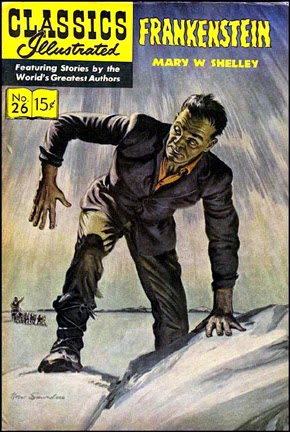
  Frankenstein #26
  Mysterious Island #34
  Poe’s Mysteries #40
  Twenty Thousand Leagues Under the Sea #47
  Around the World in 80 Days #69
  The Gold Bug/The Tell Tale Heart/The Cask of Amontillado #84
  King Solomon’s Mines #97
  War of the Worlds  #124
  The Time Machine #133
  First Men in the Moon #144
  Invisible Man #153
  Food of the Gods #160
  Robur the Conqueror #164

In this day and age of reduced reading habits and reduced comprehension, comic books/graphic novels can be a way to hook kids into reading.  This isn’t to say comics and graphic novels are just for kids – by no means.  A love of reading is one of the most important tools you can have in life.  I had previously said before it was my father reading Tintin books (and others) to me, when I was still years away from attending school, and that got me hooked on the idea of reading even before I could read myself.  Parents, read to your kids if you love them and no age is too early to demonstrate reading to them even if they are too young to read them selves.

                                              CoastConFan

Footnote
*The Man Who Laughs (1928) a silent firm starring ConradVeidt, is based on the Victor Hugo story from 1869.
 
Other Links of Interest
List of Classics Illustrated Comic Books  http://www.tkinter.smig.net/classicsillustrated/list.htm

For those of you interested in those earlier SF periodicals check out this Pulps Primer:  http://io9.com/5680191/where-did-science-fiction-come-from-a-primer-on-the-pulps   and one on the origin of SF pulps:  http://www.pulpdom.com/history.html

For those interested in pulps covers of all types, check out this blog on just this subject:  http://pulpcovers.com/


An archive of pulps, many of which are downloadable   https://archive.org/details/pulpmagazinearchive


Project Gutenberg has the full text versions, in several formats, of these same stories for download for free:  https://www.gutenberg.org/ 
No, sorry this is just a spoof cover CI never made one
 

Monday, February 16, 2015

Happy H. P. Lovecraft Mardi Gras to You All -- Cthulhu Mythos Based Figures


The Mardi Gras season has about ended here on the Gulf Coast with Fat Tuesday looming in a couple of days.  This year Friday the 13th was followed by St. Valentine’s Day and just a few days later, Fat Tuesday will begin and signal the ending of the Mardi Gras season for 2015, so it seemed a post was in order with this plethora of diametrically opposing holidays. 

New Orleans is linked to one the most central of Lovecraft mythos stories, The Call of Cthulhu, which was written in 1926, but did not see print until February 1928 in Weird Tales.  Interestingly, Lovecraft didn’t actually visit New Orleans until June of 1932[1], eventually getting in touch with author and editor Edgar Hoffman Price at his apartment in the French Quarter near where Lovecraft stayed at a hotel.   Mutual correspondent Robert E. Howard had alerted Price via telegram to Lovecraft’s presence in the Crescent City and that led to a writer’s confab that lasted many hours.  I only wish we could have a transcript of their long conversations.  It’s just too bad that Robert E. Howard couldn’t have made that meeting in NOLA, but the stars just weren’t right. 
Well it wasn’t even close to Mardi Gras in June ‘32 when H. P. Lovecraft paid a visit to New Orleans.  But the weirdness and rule of inversion that is the soul of Mardi Gras just seems to lend itself to his writings nonetheless.  The human arbitrary temporal measure of days and times just don’t seem to work within the magic crescent of New Orleans so the fact that Lovecraft wasn’t in N.O. during Mardi Gras.   Synopsis of the story, Call of Cthulhu  
With all that said, to celebrate the 2015 Mardi Gras season, I put together a photographic ad hoc tableau of artifacts celebrating a H. P. Lovecraft New Orleans Mardi Gras and the looming end of the 2015 season in the mood of his story Call of Cthulhu.  Featured in this photo set is a 19th century Italian cast iron mask form for making traditional carnival masks, as well as a fairly old conch horn, typical of the Caribbean and used in certain rites not condoned in the Catholic Church.  In voodoo ceremonies the loa, Agwe[2] is called with one of these conch shell horns.   
Scattered about the photos about are some original Native American Gulf Coast potshards dating from before the “discovery” and colonization of the area by D’Iberville in 1699.  The flints are imports that the Biloxi Indians and other coastal tribes traded for with northern tribes, as there was no local source on the coast.  These also predate “discovery” so they are fairly old.  As background, I have included an interesting French contract document dating to the 1680s.  Although it has little to do directly with the proceedings, it just seemed too cool to not have in the photo, with its intricate stamps and the hand-laid paper.  A note to prop makers, the 300 year old paper is not yellowed nor does it look like the edges were burned.  Also in the picture is a (20th century modern) hand-hammered iron knife made from a single piece of iron with a dragon handle.  Although not old, it also seemed rather appropriate for inclusion in a Weird Fiction tableau. 
In the story, Call of Cthulhu, inspector John Raymond Legrasse[3] of the New Orleans police contacted the American Archeological Society in 1908 about a figure found, “in the woods and swamps south of New Orleans during a raid”.   Previously Legrass had captured some items from a voodoo meeting.  He led a party of police who found some “oddly marred” bodies used in a ritual.  But you know the story.  If you haven’t, you can download the story from the links below.  Consider that these items are from Legrasse’s collection made over a number of years. 
The swamp featured in Call of Cthulhu was supposed to be quite close to the French Quarter, just outside the original old walls of New Orleans.  This leads me to believe that the area suggested just might be near Chalmette, which coincidentally is the site of the Battle of New Orleans, which just so happens to have celebrated its bicentennial just last month on the 8th of January 1815.  The coincidences just seemed to be too good to pass up! There is an interesting military graveyard at the site dating from 1815 to the near present.

Anyway, most of the figures, icons, and the like in these photos were made by that ceramic artist Michael Moses, whose diversity shows in the plethora objects he has made over the years.  The rest of the items are a mix original artifacts, one of which is the voodoo related conch horn.  Some other items here are antiques dating from the time of European “discovery” or before.   The Mythos ceramic figures are made of pottery clay and fired at a high temperature (twice) and should last centuries, even when dropped in a swamp.
Mardi Gras has always had a wild kind of pre Christian flavor, so this assemblage seems to work out well in association.  I thought a cornucopia of Chthonian goodies would be a fine ending to the season.  The collection needed a little airing out so a photo shoot just seemed to follow.  Hopefully this will get folks reading HPL’s Call of Cthulhu, if they haven’t already or at least be amused by the assemblage of items, both original and spurious.  Keep on reading.             CoastConFan
Footnotes:
     [1] Info on Lovecraft’s visit to New Orleans http://mfkorn.blogspot.com/2009/02/new-novel-sold-and-mention-made-of.html and  https://tentaclii.wordpress.com/2012/02/02/lovecraft-and-new-orleans/
  
   [2] As a bit of coincidence, see also Kenzaburo Oe’s story, Aghwee The Sky Monster from his book, Teach Us to Outgrow Our Madness (1994).  See https://en.wikipedia.org/wiki/Agw%C3%A9
Additionally, one of Michael Moses’ other pieces of pottery is called The Day he Himself Shall Wipe My Tears Away (not shown).  Here's another one, the loa called Agassou, one of Papa’s Agwee’s crew, is in the form of a crab.  Now it just so happens that Agassou is close in sound to Sargasso – the place of giant crabs and groping tentacles in the novella, Boats of the Glen Carrig by William Hope Hodgson (see my post about same), whose influence on HPL is discussed therein.  This is all just happy coincidence and makes the story work even better by this bit of serendipity.  See https://en.wikipedia.org/wiki/Agassou  and  http://altreligion.about.com/od/symbols/ig/Vodoun-Veves/Agwe.htm .  Also Agwe's female counterpart is La Sirene, the siren of the seas, the conch horn also comes into play with this.  It doesn't take much of this kind of loose association to make it all appear to be part of the whole narrative. These kinds of random and weak association can enhance the backstory of a prop or in a RPG/LARP scenario sequence. 

    [3] John Raymond Legrasse, inspector of the New Orleans police from 1904 to 1916, after which he enlisted in the U.S. army.  He was discharged in 1919 after a tour in the military police and returned to New Orleans.  Born in 1874, in New Orleans, Legrasse was of Creole descent and educated at parochial schools and later at Tulane.  He was in the N.O. police from 1894 to 1916 and again from 1919 to 1927, after which he retired.  Legrasse passed away in 1932 and his estate funded the Legrasse Endowment for Cultural Studies in 1932.  The collection was housed in a private residence for years.

Some links of interest to you Lovecraft and New Orleans fans

CoC RPG ref  Sourcebook for New Orleans   http://www.yog-sothoth.com/wiki/index.php/The_New_Orleans_Guidebook


An kickstarter article about a NOLA-based CoC set of RPG scenarios   https://www.kickstarter.com/projects/goldengoblinpress/tales-of-the-crescent-city-from-golden-goblin-pres

An overview of some CoC RPG titles https://www.sfsite.com/11b/chao21.htm

Free downloads of the story, Call of Cthulhu

The complete works of H. P. Lovecraft for Nook and Kindle (free -- why pay more) http://arkhamarchivist.com/free-complete-lovecraft-ebook-nook-kindle/

The complete works of H. P. Lovecraft in PDF form (708 pages) free again -- https://maggiemcneill.files.wordpress.com/2012/03/the-complete-works-of-h-p-lovecraft.pdf

Some posts about the Cthonian inspired ceramic works of Michael Moses


Cthulhu reverse glass painting icon by Michael W. Moses  http://coastconfan.blogspot.com/2010/09/cthulhu-icon-painting.html


A little lagniappe:  An article by Robert Bloch, Poe & Lovecraft, 1973:  http://alangullette.com/lit/hpl/bloch.htm
 Text Copyright © by William Murphy, aka CoastConFan, 2015  
as well as some photos.

Sunday, February 1, 2015

Collinsport, Arkham’s Sister City, a Weird Fiction Playground for the Call of Cthulhu Gamer


Tucked away up on up on the coast of Maine, Collinsport is the (fictional) home of the Dark Shadows TV show fame.  With a plethora of information put together by Dark Shadows fans, consider playing the H. P. Lovecraft mythos RPG, Call of Cthulhu in beautiful downtown Collinsport for a change of pace, if Arkham becomes a bit too expected.

If you are of a certain age, you remember running home from school to catch the latest episode of the daytime soap opera, Dark Shadows.  It was an afternoon weekday TV show that ran from 1966 to 1971 originally.  But it was a bit different because it was a horror series, something not seen in a daytime slot.  There were 1,225 episodes overall and a couple of movies+.  The series starred the notorious vampire Barnabas Collins as played by Jonathan Frid and featured a parade of Frankenstein monsters, witches, zombies, and werewolves.  The show also had time travel story lines and parallel universes.  Clearly there is enough ground there to please any eldritch gamer.

Although obscure to most of you today, Dark Shadows was a huge hit in its heyday in the late 1960s.  Today, the episodes are all but unwatchable by modern standards, but Dark Shadows brought in slow pacing, tropes, and memes that we see more often in our modern graphic novels these days.  Dark Shadows was ground breaking and had a good deal of influence even years after the show went off the air.

There was also a bit of Lovecraft’s Cthulhu Mythos connection in Dark Shadows.  The story arc, The Leviathans, brought some Lovecraft stirrings to the TV series, although fans really didn’t like seeing Barnabas as the pawn of the Old Ones.  Given the parallels with Lovecraft Country, working on scenarios in Collinsport wouldn’t be too hard.

A couple of links about Collinwood Mansion the lair of the Collins family and Barnabas himself:   https://en.wikipedia.org/wiki/Collinwood_Mansion  and  http://darkshadows.wikia.com/wiki/Collinwood

Well worth your time is a trip to the Dark Shadows Wiki, which has tons of useful information: http://darkshadows.wikia.com/wiki/Dark_Shadows_Wiki

Pictured is a map of Collinsport drawn by Jean Graham at Dark Shadows wiki  http://darkshadows.wikia.com/wiki/Collinsport

Playing in Collinsport in the 1920s would prove to be a lot of fun for those who don’t mind a bit of initial preparation.  Being contemporary with Arkham and the Cthulhu mythos works well, especially since most folks are not familiar with Dark Shadows enough to find continuity errors in your home-build scenarios if you color outside of the limes somewhat.

Here’s a bit of background to pique your interest in adding Collinsport to the topography of Mythos haunted New England.  To show you how much fun Collinsport might be, I gleaned a few things from the series itself, but other parts I extrapolated, borrowed or made up whole cloth.  Pay a visit to beautiful Collinsport sometime, especially in the 1920s.

Collinsport was founded in the 1620s but began a decline from the 1870s onward as a fishing village.  By the late 1890s, it’s picturesque quality attracted summer visitors escaping the summer heat of large cities.  Plus it was a lot cheaper than other resorts.  The railroad made the village accessible.  Note that by 1962 the railroad stopped making daily scheduled stops, due to lack of traffic and the decline of fishing industry cannery cargo.  A seasonal artist colony sprang up just after WWI.  It was a quiet place for relaxation in seclusion.  The townspeople were insular and often uncouth and the village did not attract “the right kind of people” and remained unfashionable.

In previous centuries ship salvage was a source of income and when that proved lean, wrecking would suffice.  Smuggling from Canada to avoid taxes started in colonial times down to the present.  Additionally the Collinsport fishing fleet ranged down to Florida in winter months to fish for the Havana market starting in 1815, wrecking there in the dangerous reefs to make extra money.  Often used Indian Key, Florida as a headquarters.

Historically, Collinsport was seldom directly involved in the slave trade from Colonial times to Civil War, although their shipping expertise would have been useful from their smuggling and wrecking days.  Some profit was made in outfitting and crewing slave ships, but the most money was made in financing the trade both when it was legal and later illegal.   Later, there was a little income from the China Trade, but not much.

Prohibition (1920 to 1933) saw some activity in Collinsport with rum running from Canada, but Collinsport’s activity was primarily as a middleman, generally by poor fishermen trying to make ends meet rather than large, national-level gangs.  Meeting larger ships, they broke down the cargo into smaller lots and hid it until they it picked up or shipped out again.  Some use of false-bottom train cars used for shipping fish were used early on, but were too easy to catch, leading to dispersal of illegal liquor throughout the fishing fleet and being hidden in spots around the coast.  There was some small-scale moonshining, but it was generally for local consumption. 

You can visit to the so-called Viking ruins well outside of town and the long-abandoned site of the old Indian village site in a clearing just down the coast.  The famous treasure pit, which sees occasional excavation for elusive gold (see Oak Island treasure).  Collinsport ships may have stumbled on treasure from the 1733 treasure fleet while “fishing” down in Florida, at least that is the origin of the story of the treasure pit.  Sometimes dark things are found at the site and there are stories of “disturbances” in the area.    Also http://info.flheritage.com/galleon-trail/fleetOf1733.cfm 

Anyway, I suggest you do a little Googling around, follow some of the links provided below and see if you don’t get excited about gaming in and around Collinsport and other haunted sites around Maine.  I think this is fertile ground for CoC or any paranormal role playing gaming and there is plenty to discover.  The background to the Dark Shadows world is interesting in itself and would lend itself creditably to some RPGing from the Victorian era, the 1920s, and even up to modern times.  The sea has always been a link to the dim, primordial past as well as a highway between cultures.  Some exploring is in order.

                                                                        CoastConFan

Footnotes
+Films made Both theatrical films, House of Dark Shadows (1970) and Night of Dark Shadows (1971).  There was also a revival movie in 2012 starring Johnny Depp

Some good links for RPGing in the Collinsport area:
A must-visit is the fan site, The Collinsport Historical Society, with tons of information  http://www.collinsporthistoricalsociety.com/

A detailed Wikipedia article about Collinsport and its environs https://en.wikipedia.org/wiki/Collinsport

Dark Shadows Every Day, a blog that reviews an episode of the popular 60 TV show each day  http://darkshadowseveryday.com/

Maine has it shares of domestic monsters and the like:  http://dsduby.hubpages.com/hub/Urban-Legends-and-Haunted-Places-the-series-Maine-Edition    

Of course, Steven King’s home is in Maine and some of his stories are set there as well.    He created a number of fictitious towns in Maine for his stories and Collinsport would fit in nicely:  http://www.syfy.co.uk/blogs/top-10-stephen-king-towns 
If this doesn’t give you enough Weird Fictional New England towns as grist for your scenario mill, then you are probably not much into gaming.

Well worth a download, American Architecture and Building News, 1890 on Project Gutenberg for building ideas and floor plans  http://www.gutenberg.org/files/21596/21596-h/21596-h.htm


Thursday, January 15, 2015

Zotz!, a Magic Amulet Right Out of Weird Fiction


A professor of archeology comes into possession of a dangerous ancient amulet.

A rather quirky movie from my youth is the William Castle “B” movie from 1962, Zotz!, which involved possession of a powerful ancient amulet that accidentally falls into the hands of an average guy.  This is powerful stuff and once word gets out, rival governments also want the amulet, of course.  Both a comedy and cautionary tale, the movie was made during the Cold War when fears of atomic war were grist for Hollywood’s movie mill. 

Stop me if your have heard this one:  A professor of archeology and ancient languages comes into possession of an amulet found at an archeological dig and sent to him by mail.  The professor can read the language and finds that the amulet is magical.  By intoning the magic word (Zotz of course) or by pointing at the target, the user can stun, inflict pain or kill.  In the book, the powers are a bit more dire, as just pointing at an human or even animal while holding the amulet will cause them to faint.  If you also utter the magic world while pointing the person will die.  In the film the professor used the amulet to slow his fall.  While not flying, this power comes in handy.

The original release of the film for theaters was in October of 1962 saw a promotional item in the form of plastic replicas of the amulet from the film.  A number of these turn up from time to time with varying degrees of accuracy to the film used prop.  A screen capture shows the original prop and a couple of snapshots show a plastic version and a metal version.  The plastic original one has the most detail.  Note the dimples on the face, which is probably from the mold ejector during the casting process.  The pot metal version lacks most all detail and there are other plastic copies that really look soft.  Clearly there are a number of copies around with varying accuracy to the one in the film or those given out at the original release of the film.

This film was based on a book by Walter Karig published in 1947 with clear indications of being a reference to the misuse of modern technology.  Karig knew all about it as he was a US Navy captain who also wrote on the side.   Interestingly Karig wrote scripts for the TV series, Victory at Sea, which was rerun on TV and another old favorite of mine when I was a kid.  Amusingly enough, he also ghostwrote three Nancy Drew books under the name Caroline Keene.*  He also wrote Perry Pierce stories around the same time.

I remember this film as a kid, but wasn’t too taken with it at the time.  Over the years, with some readings in Weird Fiction and H. P. Lovecraft and the like, my interest returned.  Especially with my interest in movie props and prop blogs, such as Propnomicon as well as costuming and role playing games such as Call of Cthulhu and the like.  So the story line works for an RPG and the ZotZ! amulet would make a great prop as well. 


I haven’t read a copy of the original 1947 book by Walter Karig that inspired it all, but it’s on my “to do” list.  I’d like to recommend another quirky book another book about an eccentric professor of Eastern cultures called When the Assyrians Came Down From the Trees (1969) by Gwendolyn Reed and Angela Conner about a professor of archeology who goes mad and begins to believe that squirrels are the descendants of the ancient Assyrians.  The illustrations become progressively more stylized in the manner of ancient art as the story unfolds and the professor’s madness takes him to the trees.  A really great children’s book. 

I learned a bit myself researching about Zotz! and Walter Karig.  I hope this post will get you out thinking and reading a bit yourself.  The idea of the Zotz amulet is not a new one by any means but it lends itself quite well for a prop in an RPG.  Also at the end of the film, the amulet disappears down a storm drain, to be found by the next person.

    *Those books were:  Nancy’s Mysterious Letter (1932), The Sign of the Twisted Candles, 
      and Password to Larkspur Lane (both 1933)

     Update:  I just found ZotZ! on YouTube, so interested parties can see the film:
The theatrical trailer is on YouTube:   http://youtu.be/3df9PGETpMs
The film itself is on YouTube in 9 sections:  http://youtu.be/uMYMA8ELcfE
For a little extra credit: 
Zotz is also a German language surname as well as a month of the 365 day Mayan Haab calendar (also as Sotz’)   https://en.wikipedia.org/wiki/Haab%27


There was a fizzing candy that came out in 1968 also called Zotz, which had nothing to do with the book or film  https://en.wikipedia.org/wiki/ZotZ_%28candy%29  and here's a blog entry on the candy   http://www.collectingcandy.com/wordpress/?p=1690

A review of the film Zotz! as well as a nice overview with photos, well worth the visit http://www.midnightonly.com/2011/08/18/zotz-1962/


         ZotZ All!

                                                    CoastConFan

Sunday, November 9, 2014

Veteran’s Day 2014


Veteran’s Day is the day we honor our nation’s veterans, but it’s a lot more than that.  I’d also like to honor their spouses and dependants as well as the many civilians who work for the U.S. military past and present.  This is a common effort and we have the common cause of keeping America free.  

I want to combine two important events in this post.  Veteran’s Day, which is on the 11th of November and the Fall of the Berlin Wall 25 years ago today, 9 November 1989.  In a sense you can say that the Cold War was really a sort of low intensity WWIII.  Unlike WWI and WWII, it wasn’t a big shooting war, but involved the whole world and dozens of smaller conflicts.  But although there were not great classic battles, the Cold War had dozens of regional wars, tens of thousands of hostile encounters and millions under the yoke of statist dictators, revolutionaries who functioned much like fascists than socialists, and a lot of money and lives lost.  The fall of the Berlin Wall is a good a date as any to mark the end of the Cold War and for once a war ended peacefully. 

I lived much of my life in that post-WWII Cold War setting, with air raid drills, the fear of atomic destruction, the terrorists funded by our enemies, the constant strain of being in an undeclared war.  There was a bit of an added dimension because I grew up as a military dependant, mostly overseas.  I was pretty much like everybody else who was a dependant overseas in those days.  At the time, it didn’t seem terribly abnormal. 

Many years later, I joined the Air Force and I was stationed in Germany.  The last time I was there it was as a dependant.  It came to pass that East Germany fell apart and as it collapsed, so did the dreaded Berlin Wall.  You know, the one they shot you for trying to climb over, under or through.  In fact my landlord climbed over that same wall as a 16 year old youth in the 1960s, leaving behind a life, family, and incidentally the tyranny of the DDR.

I was stationed at a base that is now closed, which is a good legacy of the peace that followed.  The guys down the hall were combat controllers and generally out for a bit of fun.  A couple of them just happened to be in Berlin on leave when the first section fell.  A big corner broke off and just lay there.  Well they grabbed it up and tossed it into their van.  Ironically, they were chased by West German police, because that chunk of concrete still officially belonged to the East German government and it must be returned.  The Berlin Wall was actually completely in East Germany and so DDR property.  It was there to keep East Germans in rather to keep anybody out. 

They escaped with their prize and when they came to the office, they triumphantly handed out section chipped off that corner to all and sundry.  Actually the whole thing as still up in the air, the DDR still existed, kinda, and the USSR was still around, but not sure what to do when East Germany just fell apart.  The Cold War wasn’t officially ended, but you could see it from here.

Soon the flea markets were full of East German flags and uniform, and followed by Soviet gear left behind by the soldiers of the USSR, who were peacefully returning home.  Somehow, buying your Soviet or East German Flag at a flea market was a lot better than taking it from a bombed out building or off of a corpse.  Often the items could be purchased directly from an ex-East German or Soviet who decided to say in Germany – besides, they needed the cash.

There’s still a lot going on in the world and a lot of wars happening, I won’t pretend that end of the Cold War stopped that.  Human nature didn’t suddenly change and not all the bad guys went away.  Some morphed, some napped for a while, and new ones have arisen.  The challenge of being free is contested both inside and outside of this country and not everybody has the same vision.  But a difference of opinion is not a war nor is disagreement.  It takes a will to start a war and a stronger will to end one, either by conflict or by conscience.   I’ve focused on the Cold War because it was one the ended magically – no atomic weapons, no hordes of Warsaw Pact tanks flowing though Fulda Gap, no expansion of Communist Chinese might in unison with the USSR.  No Red Dawn.  

For those who fought the hot wars, the proxy wars, the wars in strange places, the secret wars, fought the terrorists, for those who were there to just show the flag on land, sea and air, I salute you.  I also salute you out there who are still standing tall, fighting physically and mentally the enemies of freedom.  For you spouses and dependants, for you old vets and you young guys just in, thanks a lot.   For those who died yesterday or 50 years, 100 years or 200 plus years ago, I hope we won’t let you down.

I choose to “celebrate” Veteran’s Day quietly with no flag waving, but just quiet contemplation.  I’ll open up that box of memories and take out that Soviet flag and that East German flag and think how cheaply in blood they were bought.  I’ll open up a box of photos of my father from WWI, Korea, and Vietnam and think it’s too bad he passed away a little before the end of Cold War.  He was also at the Pentagon and SAC, so he saw the big picture.  Maybe I’ll just have a beer and think how it’s forbidden in some countries and look at my books and think about how most of them are forbidden as well.  Enough somber thoughts.  Remember that your brain is your most powerful weapon. 

Since this is a SF & F blog, here are a few books of speculative fiction and SF that you might enjoy reading.  I’ve read these books and like the each for a different reason.  This only scratches the surface and doesn’t cover much ground, but these are the first five that I came up with off the top of my head.   Happy reading.     CoastConFan

     The Man in the High Castle, 1962, Phillip K. Dick
     Europe Central, 2005, William Vollman
     Nineteen Eighty-Four, 1949, George Orwell
     Fatherland, 1992, Robert Harris
     The Iron Dream, 1972, Norman Spinrad


Links of Interest

It’s not much but some restaurants are offering free meals for active duty members as well as veterans.  Click on the link to find out more:  http://themilitarywallet.com/veterans-day-free-meals-and-discounts/

 
UPDATE Dec 2014

I recently saw the 2006 German language film about the dark days of the DDR,  Das Leben der Anderen, (The Lives of Others) about a Stasi operative who becomes entangled in the passions of playwright while spying on him.  I’ve got to say that I was impressed with the film and I’ll have to locate a copy of the book in English.

On the lighter side of East Germany is the comedy film about an East German man who was in a coma for years only to awaken after the Berlin Wall has come down and the two Germanys have been reunited.  Good Bye, Lenin! (2003), is a chuckle, but you really have to know a bit about the old DDR to get the jokes. 

An older comedy film about the DDR, but filmed just before the Berlin Wall went up in August 1961 is the film, One, Two, Three (1961) starring of all people Jimmy Cagney.  I saw this one again a few months back on TCM after a long hiatus.  It’s not nearly as good as the previous films nor as good as the excellent Cold War farce, The Russians Are Coming, The Russians Are Coming (1966), which holds out a bit of hope during the depths of the cold war.  Then again, The Russians Are Coming doesn’t take place in Berlin, and there are no East Germans, so it really doesn’t count in this listing.

There’s a lot of movies set in Berlin from the silent era to the present, and you can find a list here:  https://en.wikipedia.org/wiki/List_of_films_set_in_Berlin