Friday, October 7, 2011

SNEAKY GUNS I: Gun Canes

They’re hidden, they change shape, they’re just plain sneaky.

This episode we look at cane guns.  They are mostly a product of the industrial revolution, the Victorian need for curiosities, and a reaction to urban crime.  Cane guns were a way of hiding a firearm inside a walking stick or cane.  
Everybody has seen sword canes and they were uncommon, but not unheard of in the Georgian and Victorian eras but gun canes are even more uncommon than other gadget canes.  But as scarce as they were overall, they were popular with a segment of the population starting in the 1840s Europe as late as the 1920s.  Slowly over the years, governments put into place laws about concealed weapons so sword canes and gun canes fell into disfavor and even outside of the law in industrialized countries.  
Most cane guns were hand made by small workshops in limited numbers, but a few major companies such as Remington, made gun canes that are now highly sought after by collectors.   

Most gun canes encountered are either late percussion era items (1840s to 1870) and early cartridge guns (from 1860 onward) nearly all of which were rim fire guns from .22 to .32 commonly, although there are a few exceptional guns such as the 410 center fire.  Rarer even in this obscure niche are flintlock, repeater, and air gun canes as well as combination weapons hidden in a cane and detachable stock canes.  

Generally, they are single shot devices although there are a few scarce pepperbox types, which tend to be rather bulky in anything but tiny calibers.  Sometimes, the pepperbox gun canes had an integral spike bayonet tip, but they are extremely rare.  There are a very few late period magazine repeaters and a few also sport attachable rifle stocks, but again they are very rare.  Cane guns were even produced by airgun manufacturers, which were nearly silent in comparison to cartridge cane guns.

The vast majority of cane guns were simply novelties and a tribute to the Victorian love of mechanical gimmicks.  They produced canes with a wide variety of attachments and uses such as concealed swords, compasses, hidden compartments, glove holder, whistle handles, mini telescopes, cameras, and the like.   

That is not to say that gun canes were never used, but certainly they were seldom encountered.  It was just a lot easier to just pocket your small revolver when you went out for a stroll if you were concerned about an encounter.   Simple sword canes are far more encountered than projectile weapons in a cane.

One added feature of gun canes is that they could be used as a parrying weapon or even a club once they have been discharged.  They were often embellished with expensive handles of gold, silver or ivory being a statement about status as much as having any practical walking value.  Assassins, footpads, dacoits, muggers and garrotters beware or at least try not laugh too much.  
Ultra-rare segmented cane gun air pistol in case with pump

 As far as using them for RPGs such as Call of Cthulhu in the Victorian, Edwardian or 1920s.  I suggest you use them sparingly except as a psychological quirk for a player, a fantastic prop in a mystery, or an embellishment for a bad guy NPC.  

They have a good surprise factor and can be deadly at close quarters despite having no sights, being in small calibers, generally single shots, and requiring a bit of practice in working the mechanism.  Stay tuned for more Sneaky Guns articles following this one.

                                                                                     CoastConFan


If you like this Victorian weapons blog post, also consider some of my earlier blog entries about Victorian weapons and crime.

----------------------------------------------------------------------------------

UPDATE 10 Nov 2011:
See my other Sneaky Gun posts of the Sneaky Guns Trilogy

Thursday, September 29, 2011

COASTCON 35 IS WITHIN 6 MONTHS OF EARTH


CoastCon, the Mississippi Gulf Coast’s science fiction, fantasy, horror & anime convention will arrive in only six months.  It will be held at the Mississippi Gulf Coast Coliseum in Biloxi MS, 16, 17 and 18 March 2012. 

The media guest is Lindsay Wagner, the original Bionic Woman, who has appeared on television and in movies for decades including recent shows such as Warehouse 13 and Alphas.

The writer guest of honor is Timothy Zahn, a Hugo winner and prolific writer of several series including the Black Collar series, Cobra Series, Conquers Trilogy, and Star Wars.  He has also written short stories and novellas one of which, Cascade Point, won a Hugo in 1984.

Please visit the CoastCon.org website for more information about the convention and for updates.
                                                                                                CoastConFan

Wednesday, September 28, 2011

FAKES, FUN, AND LEAD CODICES

Make your own Unspeakable Cthulhu Codex

I love a good prop or fake, but when one tries to sell the item as original, then that goes beyond a hoax and into the area of criminal fraud.  When these appeared earlier in 2011 with a lot of press hoopla, I had strong suspicions about them being fake.  Somehow, they just didn’t fit in with finds of that period, but I held my tongue while actual experts viewed the images since my Hebrew and Aramaic is pretty shaky.  Most of the text was lifted from other sources and many of the images were as well.*  Well, we can learn something even from counterfeits and fantasy objects.
                                                                            CoastConFan

Please note that these are not intaglio (carved into) the lead, but they are convex, which means they were cast from a master mold.  I think it would be an easy matter to make a Cthulhu Codex using the same method.  I don’t encourage you to use lead it has toxic fumes.  You might try making the reversed master out of plaster, carving it while wet.  Then use Femo or another polymer clay to make an impression.  You need only paint and age and you have a page for your Unspeakable Codex.  You could try casting with a metal such as zinc or safe casting metals, but be careful of getting burned.  Frankly, polymer clay is a better idea because you can tweak up the impression for more detail. 

*For example the head of Helios and Alexander as found on Greek coins and the star bursts are common on Hebrew coins, see the so called Widows Mite.  Check out some of these links about the lead codices and some legitimate scholarly criticism:

http://rogueclassicism.com/2011/03/30/lead-codices-silliness/

Check out this YouTube video:


Monday, September 26, 2011

CASE STUDY: JOHN CARTER, CAPTAIN, CSA

Insanity, delusion, amnesia, guilt, and wealth

Found recently is an early image of Captain John Cater, CSA who after the Late War, prospected in the Arizona Territory, finding a vein of gold and perhaps something else.  He later retired to a small house in New York State along the Hudson River, dying on 4 March 1886.  He left a peculiar will behind and a quantity of documents, which were discovered over the course of years.  Among many peculiarities of his life was his tomb, which was specially constructed while he was alive to be unopenable, except by a mechanism located within the tomb itself. suggesting he also had a fear of catalepsy along with the delusion of time and space travel.
John Carter, Circa 1862

He claimed to have been chased into a cave in Arizona while prospecting by marauding Apaches where he astrally projected himself to another planet he called Barsoom.  There is some conjecture that Barsoom was actually Mars a half million years ago, which meant that he believed he not only projected himself over millions of miles but over hundreds of thousands of years in the past.  Carter also had selective amnesia, claiming to have no memory of a time before the Civil War.   

Being wealthy, he avoided being sent to a sanitarium and hid away in his cottage in a remote area until his premature death in 1886.  His death certificate has disappeared as well as nearly all records of his life outside of this photograph and some military records with the Virginia cavalry.  Carter obviously had an accomplice who destroyed documents, dropped off packages of documents over the years and sometimes masqueraded as Carter “Uncle Jack” after his death.

Outside of his well written delusional dreams, which were subsequently published as fiction by Edgar Rice Burroughs, a few records, and this photo, there is no proof that John Carter had even lived.  His birth, baptismal, and most military records and, most curiously, his death certificate disappeared.  There have been rumors that John Carter became an immortal, not just on this world, but also on several worlds over a huge span of time.  That conjecture dwelled upon too deeply might just land you a billet in the Arkham Sanitarium.  This image is part of an exhibit at the Rhode Island Museum of History about the history of mental treatment of delusional persons.
                         
                                                                                                CoastConFan

Project Gutenberg has free downloads of several text modes as well as some audio books of the following books:  Princess of Mars, Gods of Mars, Warlord of Mars, Thuvia Maid ofMars, Chessmen of Mars, Pellucidar

Wednesday, August 31, 2011

Arkham Sanitarium Project


With these new props, you can simply go mad.
Propnomicon has produced a number of interesting props for use on his blog.  Recently, he made a more modern Arkham Sanitarium logo.  Earlier he had an earlier style Arkham Sanitarium woven patch, which I used at a local convention as part of an understated costume.  It was simply a blue blazer with the patch, black pants, tie & etc.  You need not go overboard with a costume to make it effective.  With that getup, I was the head of the board of directors of the Arkham Sanitarium.  Please don’t ask about funding your project, it’ll be taken up at the next board meeting.

His more modern large logo works well as a magnetic sticker or adhesive sticker to put on vehicles such as ambulances, vans and official vehicles of the Arkham Sanitarium.  If you go with the magnetic signs, it can be removed easily and put on another vehicle.  You can drive up to your next convention in style with these signs on your car and sport your blazer patch in elegance.  In these days difficult days of high expenses, an inexpensive and versatile prop can go a log way.

Arkham Sanitarium Ambulance
I’m hoping Propnomicon will have some Arkham Sanitarium commitment papers made up for use.  They’ll go well with the suit.                                          CoastConFan

Tuesday, August 30, 2011

Plague and Costume


The image of the plague doctor with his peculiar protective costume is well documented by period descriptions and engravings. The best known is Der Doctor Schnabel Von Rom by Paul Furst although there are several other images.  A quick image google of “plague doctor mask” will uncover a wealth of images from costumers and historical sources.

This is basically an early chemical warfare protective suit because during that period doctors believed that plagues were caused by bad or poisoned air, better known as miasma.  Starting in the 14th century, plague doctors began putting together protective costumes to try to avoid infection and over the years the costume stayed basically the same.

As may be seen on picture here,  
In Rome the doctors do appear,  
When to their patients they are called, 
In places by the plague appalled,   
Their hats and cloaks, of fashion new,  
Are made of oilcloth, dark of hue,   
Their caps with glasses are designed,   
Their bills with antidotes all lined,   
That foulsome air may do no harm,  
Nor cause the doctor man alarm,   
The staff in hand must serve to show  
Their noble trade where'er they go
   
The black hat is distinctive for doctors of the period and identifies the wearer as a practitioner.  The beak mask is a gas mask made of leather with the front end with strong aromatic herbs and spices to kill off or deter the miasma, the supposed origin of plague.  At best, the mask cut down on stench.  The eyes were protected with glass where could be clear or red which would filter out evil hopefully.  The long black overcoat was coated with suet or wax to make the suit waterproof, which actually functioned to protect the wear from respiratory spray in the case of pneumonic plague.  The other explanation is that the material would attract plague away from a living person.  The overcoat collar was tucked in under the mask to make a seal for the vulnerable neck area.  The wooded cane was used to pull back bed sheets, uncover the patient for inspection, push back crazed patients or relatives and otherwise be uses as a manipulator to keep from touching infected persons and keep victim’s relatives at bay.  Leather breeches were worn to protect against plague attack, because bubonic plague manifests itself in the armpits, neck and groin.  In some cases the breeches were made with attached feet like hip waders.  Leather gloves were also worn.  No part of the body was exposed to open air, keeping the doctor safe from infection.  The death rate among doctors was no better than the unprotected populace.

This terrifying costume is also associated with Commediadell Arte in a character called Medico della Peste and it remains a popular mask for Venetian carnival.  Sometimes the mask has a set of overlarge spectacles, which were rare and associated with learning.
 
The image of the plague doctor continues to intrigue costumers and gamers.  There have been a few modern imaginings produced by modern mask makers and costumers.  The specter image of the plague doctor has come down to us from the ages and takes shape again in carnival costumes, steampunk costume ideas, and science fiction convention costumes.

One of the most provocative mask makers I have run across is Tom Banwell who also makes a Plague Doctor mask as well as great tutorials about mask making.
                                                                                               CoastConFan

Saturday, August 20, 2011

TinTin in The Dreamlands

A Call of Cthulhu RPG- Tintin crossover idea.

Put a twist in your gaming ideas and imagine if TinTin was to end up in the Dreamlands of H.P. Lovecraft with Capt Haddock and Snowy, his wisecracking dog.  The Dreamlands can be entered via dreams or physically by going down a certain staircase in a ruined city.  Both are fraught with great danger, both mental and physical.  Both you and your dream state self can be killed if you make a mistake or a misjudgment. 

TinTin in the DreamlandsThe Dreamlands can vary wildly from near normal to the utterly fantastic.  Generally people forget the Dreamlands when they wake from their dream, but those few, I dare not call them lucky, remember it all.  A very clever gamemaster might be able to blend a regular Call of Cthulhu RPG game and a Dreamlands scenario, but it takes a fine sense of judgment and a good deal experience. 
I recommend running this scenario either in the 1920s or in the early 1950s although the Victorian Era would not be impossible.  The setup might be:  a colleague of the professor (one of your party or a friend of one of your party) disappears leaving behind a locked room with a lot of odd electronic devices.  Upon reading the documents in a locked cabinet they find out that the doctor had originally been experimenting with sleep therapy.  Over several years, he found that a rare drug coupled with his invention would place a person in a state very far beyond regular REM sleep.  Boxes of radio electroencephalogram printouts show a huge amount of brain activity in subjects when in this state.  His records become quite erratic in the last few months and he hints at a great discovery.  Another box contains a peculiar bronze dagger and some coins that the origin or language cannot be identified, although the metal is electrum, which hadn’t been used in coinage in over 2,000 years.  There is also a common small cay pot that is empty, a few pebbles, and a feather that cannot be identified.  A pile of other papers have number of landscape drawings show quaint towns, strange ruined cities, and nightmare creatures.  Some of the sketches seem to be from patients and others might be the doctor’s works.

Mind you, I would have a couple of alternate possibilities:  (1) it is the dreamlands and you have to rescue the doctor, (2) the rare medications actually just made you crazy and the doctor is crazy himself, he disappeared on his own, (3) nefarious criminals, quasi-government or religious zealots want the equipment for themselves and they did away with the doctor or he has fled to the dreamlands to escape, (4) the doctor is a dangerous quack who is trying to get back at the professor for trying to find out what is going on, the upshot being that this is an attempt to kill or disable the group.  You take it from there, the point is to instill curiosity, and fear in the group, both of the real and of the imagined.  Keep them on their guard and not ever sure that this is a legit case of Cthonianism.
                                                                                             CoastConFan


For more crossover fun see my post Call of Cthulhu RPG – Minions, Cultists, and Scooby-Doo, posted Friday April 29, 2011.

Thursday, August 18, 2011

Guennol Lioness

A True to Life Treasure
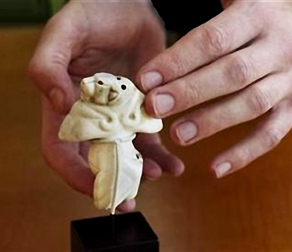
 This is a very famous stone sculpture called the Guennol Lioness.  It’s not only one of the smallest, but also one of the world’s most expensive figures, selling for $57.2 million and it stands a whopping 3 ¼ inches tall.  Made of crystalline limestone, it is a tribute to the unknown master’s hand that created this diminutive tour de force.  It’s also one of my favorite ancient figurines. 

It was carved about 5,000 years ago in the  Proto-Elamite, Chalcolithic era, giving lie to the belief that earlier cultures were not as advanced aesthetically or artistically as modern people.  It was found in the middle 1930s in southwest Persia (now Iran) and sold to a private collector and displayed in the Guennol Collection, which was exhibited in various museums.  The lionesses’ powerful lines come through despite the small size, giving us a feeling that this anthropometric creature was imbued with great power.

The statue came to my attention several years back when it was put up for auction and new photos were made and released to the public.  Previously, there were only grainy pictures in archeological texts, now we can enjoy the figure’s magnificent lines in crisp, new photos and wonder in the power of an ancient stone carver’s art.  The holes at the top of the head may have been attachment points for a crown or some other embellishment and the holes at the base of the spine might have held the figure upright.  The lower legs and feet are gone and we may never know exactly how it was displayed.


For Call of Cthulhu RPG players, this is just an example of rare treasures that were found in the 19th and early 20th century.  Imagine a power play for possession of such an artifact that could be hidden nearly anywhere and in anything.  It is easily concealable on a person and transported, making everyone not above suspicion.  It could be hidden in a child’s doll, a box of candy or carried by an unsuspecting mule a treasure like this men would kill for, museums would bid for and people would spend their lives digging in the ends of the Earth just for the hope of possession.  A scenario could easily be written about this real-life "Maltese Falcon" for RPGs.  Truly, it is "the stuff dreams are made of."
                                                                                      CoastConFan

Tuesday, August 9, 2011

Peter Saxon: Guardian, Author and Figment


I didn’t know that I didn’t know

The other day I made a comment to a post on Propnomicon’s blog site.  It was about a neat prop pen made from a bone and steel nib.  Anyway, I got thinking about Peter Saxon and the series of books he wrote about a group called Guardians who protected the world against sorcery and black magic.  I had read several of his works back in the 1970s but just didn’t know much about the author.

I was surprised to find out that there was no author by the name of Peter Saxon and that it was a house name.  That is to say, it was a pseudonym used by a variety of authors writing a series of books issued by a publisher.  From what I could find Peter Saxon was actually, W. Howard Baker (who was also known as W. A. Ballinger) Rex Dolphin, Stephen D. Francis, Wilfred McNeilly, Ross Richards, and Martin Thomas.  Not all of these authors wrote books for the Guardian series, but did publish through the same house.

Here is a list of books that appear under the house name Peter Saxon although not all of these were of the horror genre nor of the Guardians series.  A few of them were made into movies such as The Disorientated Man, which came out as Scream and Scream Again with Vincent Price, Christopher Lee, and Peter Cushing.  How can you beat that combination!  Black Honey and Corruption were also made into films, although I haven’t seen them:

 
 The Curse of Rathlaw
Dark Ways to Death
The Haunting of Alan Mais
The Killing Bone
Through the Dark Curtain
The Vampires of Finistere
The Torturer
Satan’s Child
Vampire’s Moon
The Disoriented Man
Black Honey
Corruption
Other titles by Peter Saxon, but not horror
The Enemy Sky
The Warring Sky
The Unfeeling Sky
Panky in Love

I read the Killing Bone back in the 1970s as well as Dark Ways to Death and Satan’s Child, but I understand The Vampires of Finistere and The Curse of Rathlaw are some of the best of the Guardians Series.  I suggest to Call of Cthulhu RPGers that these Guardian series books by Peter Saxon would be good scenario ideas for a game master.  While doing research I was utterly horrified (pun intended) to find no Wikipedia entry for Peter Saxon.  I hope some enterprising fan of detective horror fiction would type up an article.
                                                                                     CoastConFan

Tuesday, August 2, 2011

Byzantine UFOs?

All is explained forthwith

Funny how the default state of most mysteries is to blame it on extraterrestrials. No matter how simple the conundrum, how easy the research, the fall back is aliens. Then again, there is a lot of money in huckstering ETs and not so much for dry old history, so it’s no wonder that genuine research on possible extraterrestrial life is muddied by popular books sellers and mystic personalities. I love a mystery as much as anyone else, but then again I like research, education, and an open mind.

I ran across this enjoyable video on YouTube explaining the iconography of, uh, ikons. I hope you will enjoy the scholarship as much as I did.


Cthulhu IconAnother good source of art history and UFOs is: http://sprezzatura.it/Arte/Arte_UFO_eng.htm . I can’t say I am any expert on medieval ikons, but I have looked a few thousand over the years and watched in Athens as they were painted. A good friend of mine, Michael W. Moses is also quite familiar with ikons and paints them, although they don’t follow the strict rules of Greek or Russian ikons. .

Alien Annunciation IkonNow for a little fun. To the right is a Cthulhu ikon made by Michael W. Moses with reverse glass painting and gilding on a slightly convex pane. The photo doesn’t show all the detail.  The other ikon, to the left, is another Michael W. Moses work called Alien Annunciation.

 Truly I would love to find life in the universe and even more so, find that it is reachable or has reached us, but through the haze of twaddle-mongers, book hucksters, popular luminaries and the like, I don’t see genuine research having a clear field with all the static generated.

                                                          CoastConFan