Friday, April 29, 2011

Call of Cthulhu RPG --- Minions, Cultists and Scooby-Doo

I used to run CoC a while back and thought I would share a few tidbits about spicing up your game. One thing I used to do was run The Scooby-Doo option. The predictability of knowing that you will be dealing with, at a minimum, cultists if not outright monsters took a bit of the edge out of the game, I found. Instead I told the players that I was going to roll secretly before the game started to determine if the whole thing was a fake or setup by standard criminals to keep people away or possibly a misguided not-very-dangerous group of occult followers.
investigators group photo
This meant that the players did not always know that there was real trouble afoot or just a Scooby-Doo kind of send up by bootleggers. Believe it or not, it really kept the players on their toes and more open to the possibility of normal circumstances, rather than being sure that everything was corruption and evil. You can also use these small scenarios to introduce an NPC, who although does not begin to be evil, forms into an arch enemy or at least become a major adversary (read this as J. Jonah Jameson to Peter Parker) who might be a local police chief, a gangland enemy or a wealthy collector of antiquities who is thwarted out of collectable items by the players. Use your imagination to build your story arc.
Necronomicon Fun

You can interweave these scenarios together to make a campaign and to speed up or tone down the play. It also allows players to gain important skills and pick up items both mundane and occult. For example, the local kooky and harmless cult of Theosophists might actually have an important book in their library or an artifact that could lead the investigators to something important. The bootleggers might have a cache of guns or money so useful in funding investigating.
Light Reading

This presumed the GM is capable of generating a series of low-impact scenarios, but still reward the players with important experience in investigation and handing out a few gems of information. It also lets them build up a network of people who might support or help the investigators over the long haul. The police would be happy that the investigators find a murderer or bootleggers or the local townspeople would be able to forward information to the investigators.
Cthulhu-Doo Where Are You

This type of play will keep the players on their toes, but not so paranoid and distrustful that it makes them over wary of every NPC, major or minor. A series of fun, one evening scenarios will also allow the group to jell as well as give the Game Master a feeling about the wants of the group overall. The combined series of minor scenarios will help you create a tapestry for the background of the group and will lend added depth to individual characters. Slow, creeping madness is always better than a huge shock and a premature end of the group.
       
                                                CoastconFan

Friday, April 22, 2011

Pickman’s Sampler – From Arkham to You

The stars are right!  The mad chocolatier of Arkham in the Little Candy Shop of Horrors has produced another confectionary wonder:  The Pickman’s Sampler, just in time for the Equinox Bunny. 

                                                                                 CoastConFan

Pickman's Sampler


Pickman's Sampler Contents
They are all so wonderful, which one will be eaten first?
Pickman's Sampler Ad from Arkham
See our Ad in your local newspaper
Pickman's Sampler -- Our Founder
They are so delightful, you’ll just lose your mind!

Sunday, April 17, 2011

LOST WORLDS PHOTO 2

I made this photo in about 1986 with my Canon  T-70 camera with B & W 100 ASA fine grain film.  It was printed on east European postcard paper, the type that you could address on the back so you send in the mail.  I used this type of paper because it made a 20s or 30s type postcard prop and gave it an instant period look.  The T-70 works great with low light when tripoded and this one had an auto exposure of just less than 30 seconds.  By using available, soft light and reflecting it with tin pie plates and white sheets, it gets a much less hard edge look and again a vintage feel.  This photo has no Photoshop manipulation and is pretty much as scanned other than the added tag.  The digital age has made photographing much easier, at least in post-production.
LostWorldsPhoto2
Clockwise from the left is a Montenegrin Gasser pistol with ivory grips from the 1870s.  They were popular in the Balkans and the Ottoman Empire from the 1870s to the turn of the century.  Above that is a cased 1930s German Zeiss Ikon camera.  The lamp base is a 1920s Carrera marble electric table lamp.  The skull is in fact a piece of pottery sculpture that is half skull and half Greek classical helmet and aged to look ancient.  I bought that piece from the artist in the 1970s and don’t recall her name.  The binoculars are French circa the turn of the century and were made in Paris.  The pipe is a Turkish made calabash pipe from the early 1980s.  The central bronze figure is a Medieval Greek Orthodox bishop’s staff head or crosier of two snakes, with articulated tongues.  The piece is slightly crushed from having been buried for hundreds of years.* This wonderful artifact was later given as a gift to a good friend.  The watch to the left is a rolled gold hunter from the turn of the century.  The book in the center is Lost Worlds, which I had since the middle 1970s and had been an inspiration with it illustrations of ruins in deserts and jungles.

I hope this post gives people ideas about photographing their props for Victorian RPGs and Steampunk..   For example, you could put together a story about the strange skull and the staff piece.  Check out my first Lost Worlds Photo post for more items.
*Information on these Greek Orthodox Bishop’s accouterments is fairly lean.  The above piece is bronze and was originally gilded.  It is missing the small central cross that rises between the snakes.  Click on this link to go to a site about the crosier to the left and other eastern rite crosiers and staffs.

UPDATE:  I found some information on Wikipedia about snake headed crosiers.

Tuesday, April 12, 2011

American Civil War Sesquicentennial -- With Added Steampunk

Today is the 150th anniversary (sesquicentennial) of the official start of the American Civil War with the bombardment of Fort Sumter on April 12, 1861, at 4:30 a.m. and lasted for 34 straight hours.  This date is the generally agreed upon date for the start of the American Civil War (War Between the States, War of Northern Aggression take what title you will), although there were earlier shots fired.  I’ll leave any political bickering and nitpicking for the plethora of other sites and create my own revisionist history, with added steampunk!
Steampunk Civil War -- Harper’s weekly Jan 26, 1861
View of Ft. Sumter in Charleston harbor, looking east to west.  The siege is lifted with arrival of aerial and undersurface relief fleet.  South Carolina is in tense negotiations with the Union about the status of the Charleston harbor forts and other Union facilities by Governor Pickens, who has offered a monetary settlement for assets and debts of ex-Union possessions.  Negotiations are further clouded by other states leaving the Union.  The Republic of Texas has pledged to support secessionists.  Cotton prices are soaring on the stock exchange.

Friday, April 8, 2011

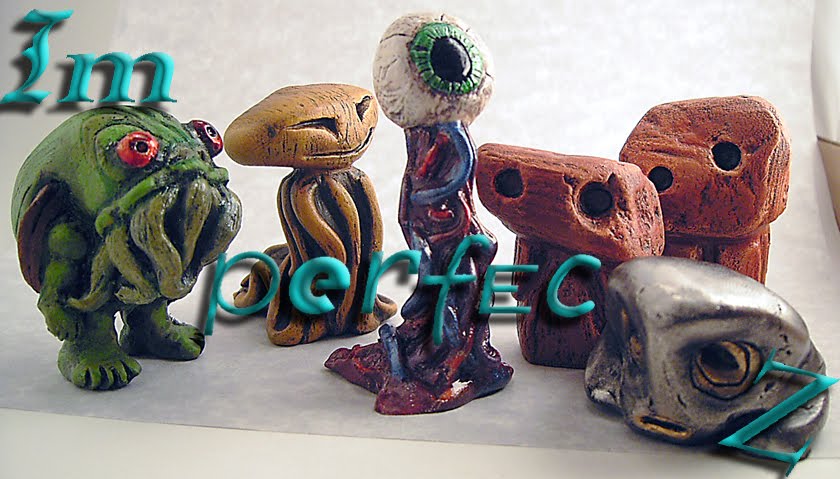
Cthulhu: I Am PerfecZ

Here is an interesting website selling gaming figures that are rather different from the general mass.  Many of these are limited edition made from a hand-built up master and cast in resin.  There is clearly a lot of love in these Call of Cthulhu and Lovecraft inspired pieces. l.designs toys!

The mollusk Cthulhu impression is also very different.  Sometimes it's good to be different!

I really like the Japanese forest spirit rock people the best, they are cute and disconcerting at the same time.  They are the very epitome of alienness and unfathomable sentience.
 
These Munchkin Cthulhu figures are hysterical (call the Arkham Sanitarium).  They are just perfect.  Click on the link to find them.

Saturday, April 2, 2011

Call of Cthulhu RPG – Be Prepared, Even When You Are Not

Or, "What has its got in its pocketses"? Adventurers find the darndest things of use in a pinch, even a found ring.

Here is a short list of handy items for a Call of Chtulhu player character to have in his/her pockets or person. Most of them are very common things, found everywhere, but oh so useful to the cunning-minded. An additional plus is that none of them are illegal and apt to be overlooked in a search. I have left off some obvious items like flashlights, burglar tools, guns and the like because they would not normally be carried everyday. This list is for common pocket items only. I suppose there is even a use for pocket lint as tinder in making a fire. The idea is to think and carry items correct for your character and era.
Turn of the century mail order or salesman sample antique clothing catalog
For example: Matchbook/lighter/matchbox, common string, magnifying glass, pen knife multi blade, small notebook with pencil, handkerchief, business cards, shoelaces, pocket watch/wrist watch, ring, brooch, paperclips and a couple rubber bands, keys, comb and pocket mirror, toothpick, whistle, a bit of wax, cough drops, gloves, umbrella/cane, hat, a piece of chalk, compass, fountain pen, coins, tobacco, & etc.


Turn of the century mail order or salesman sample antique clothing catalogMatches or lighter is pretty obvious: make an emergency light or set a fire. Common string is more than just tying up packages – with a bent paperclip as a hook you can fish for a key or open a latch. Stout enough string can make a trap to trip or make a racket. Magnifying glass can start a fire, make glyphs large enough to read and all the typical uses. Pen knife is seldom considered a danger, but many have screwdrivers, scissors, file, along with a small sharp blade. Business cards can be left as a sign to others you have been there, work as a makeshift note card and make a nice shim for wiggling tables at your favorite restaurant. A whistle or compass may be on your watch chain. Watches are import for telling the present time and for telling time elapsed. You can also use a watch to calculate speed if you are handy. Paperclips can be bend into various useful shapes. Rubber bands have uses too if you are going to be a Mac Gyver type character. At the least, you can shoot them at each other.
Turn of the century mail order or salesman sample antique clothing catalog

A bit of soft wax can be used to make an impression of a key or a seal stone. It will also burn. Cough drops are just nice to have. You can use the rubber bands to launch the cough drops at people. A piece of chalk is always useful whether you are in a sewer or making a journey to the center of the earth. A compass is obvious, but they are also set into knife handles and the like. Some items are always on your person like cuff links, neck ties, coat buttons, hat pins, glasses, false teeth, handkerchief and would elicit no surprise from somebody searching you and would be in no danger of confiscation by crooks, culties or police.   That bit of twine or loose button just might save your life.  Think, think, think.


Update Sept 2015, Propnomicon has an excellent article about what people used before duct tape – adhesive plaster aka sticking plaster.  It seems a very necessary article for the 1920s and 1930s adventurer and is often overlooked in the inventory.  I certainly did.  His article is well worth viewing.  http://propnomicon.blogspot.com/2015/09/before-there-was-duct-tape.html 

Sunday, March 27, 2011

The Werewolf Paradigm – Fun vs Rationality


As cool as werewolves are now in popular fiction, the left side of my brain has some problems with the science of transformation although the right side of my brain just goes along with the ride. I order to keep from having a corpus callosotomy at Arkham Sanitarium; I had to investigate a bit.

Wikipedia has an excellent werewolf article that I highly suggest as background. Popular films and shows have evolved from the depiction of depraved monsters to those with a human side onto a highly sympathetic view. Click on the link to see a list of 20 essential werewolf movies.
 The British TV series Being Human is a good example of the perils and travails of the modern werewolf.  Now in its third season, it’s a fine example of the modern view of werewolves. The U.S. attempt is frankly not worth viewing if you have already seen the U.K. version.

LycanthropyResearchCase2LycanthropyResearchCase3
OK, lets get down to the left side of the brain stuff: Where the heck does the energy come from via lycanthropy, to reshape the skeleton and produce all that fur. Fur is protein and that much fur would take a lot of calories. The second problem is where does all the body mass come from? Many stories have werewolves that are bloody huge and mass three to four times a human. Also once the werewolf returns to human shape, where does all the mass go? The fur could just fall out, I suppose and the bones return to their original shape, but where do you put an extra 300 pounds plus?


The whole werewolf silver vulnerability gimmick is apocryphal and is pretty much laid out in the Wikipedia article Silver Bullet.  The gist of it is that the idea was brought up in the mid 1930s in film and novels, although there is some possible folkloric linkage.   The article also has a nice paragraph about the feasibility of silver bullets, for those of you with a ballistic bent.  The silver vulnerability thing is also brought up in the main Wikipedia article on Werewolves.  Silver bullets and silver cane heads just don't work outside of movies.
werewolfThe right side of my brain just tells me to mellow out, it’s just a story and I don’t have to act like such a fanboy about it all. The left side side tells me it makes no rational sense.  Such is life.

The most surprising thing I found out with my delving into werewolves was that the silver bullet thing was a very recent invention. I guess this means I can unload my blunderbuss and cash in on all those silver dimes I had loaded up in there.  Then again maybe not, see the UPDATE 22 Jun 2014:  see below

Additional links of interest
An link leading to a pdf of a doctorial thesis,  The Girl and the Big Bad Wolf:  The Connection Between Werewolves, Killers, Child Death, and Little Red Riding Hood in History and Story by Amanda Power, April 2006, 44 pgs.  Download here:  http://www.mun.ca/vpacademic/power_paper.pdf

An article on werewolves in LiveScience: 
http://www.livescience.com/24412-werewolves.html

Werewolfpage.com has a listing of 23 folklore stories about werewolves:  http://www.werewolfpage.com/myths/folklore.html

German Werewolf
Gwthomas.org has a listing of Victorian novels that feature werewolves:  http://www.gwthomas.org/victorianww.htm

The NAZI Werwolf organization of WWII:   https://en.wikipedia.org/wiki/Werwolf
Also note there was a precursor, which was a post-WWI paramilitary Freicorps Werewolf organization in the early 1920s.

The above pictured werewolf padlock is on Restraintsblog: Story Padlock The Werewolf  http://restraintsblog.blogspot.com/2009/06/story-padlock-werewolf.html

Also a great Victorian blog:  Writers in London in the 1890s, Bram and Emily:  Vampires to Werewolves.   http://1890swriters.blogspot.com/2013/08/bram-and-emily-vampires-to-werewolves.html

An update on Vampire Hunting Kits -- although not about werewolves, they are associated with vampires, at least in Hollywood and in 21th century novels: 
Vampire Hunting Kits Debunked, June 17, 2014

A free download of The Were-Wolf by Clemence Housman   http://www.gutenberg.org/ebooks/13131  


UPDATE 22 Jun 2014:  in the comments section of Vampire Hunting Kits Debunked, 17 Jun 2014, Graham1973 gave an excellent link to a discussion about silver in reference to silver and lycanthrophy in folklore.  Clearly there are indeed pre 1930 references with werewolves and silver.  The upshot of the article is that silver as an evil magic dissipator as used in these folklore stories that date back some 300 years.  The main theme is that the silver item is a common thing like a silver button or coin most often and it is fired at or above the evil being.

Oddly, there is not a great lot of literature cited about using non-projectile silver weapons such as maces, daggers or swords against such creatures.  The additional interesting link is that generally the silver object in question is a personal object and a sort of ad hoc lightening rod against evil.  The other thing is that the silver projectile is not grounded, in the sense of being connecting a kind of grounding circuit, which would be the case with a wielded silver mace or other silver appliance.
 

The other reference is about an assassination attempt against a non lycanthrope in the hope that the would given by a silver bullet would not heal.   In this case it would convey a sort of curse of non-healing. 

 I’d like to thank Graham1973 for this excellent listing about the general of silver in dissipating evil.  I was unaware of the link and feel it is important enough to put into this blog in the body of the post so it won’t be overlooked.  The original comment was in Vampire Hunting Kits Debunked.

 UPDATE June 2016
Here’s an interesting excerpt from the book, A Modest Enquiry Into the Nature of Witchcraft, by Rev John Hale, orig pub 1697, 1702 edition, Chapter XII, Pps 84-85. 

 “Tells of a Woman confessing her self to a witch, who pretended she had been turned into a Wolf & filled a Sheep & Cow in that shape, and the Cow & Sheep were killed at that time.  And of a man Wolf that was suspected in that shape, to devour Cattle, and his face had several scratches and hurts, which they said were given him by the Dogs that took him for a Wolf …that twice a year he was changed from a man to a Wolf. “  But Hale disputes this saying, “But his change could not be real, but an abuse of a Phantasie, either from a distracting Melancholy called Lycanthropia, whereby he imaged he was transformed into a Wolf.”

That’s pretty interesting that as a local minister, who attended the Salem witch trials in 1692, would find that the wolf man story to be a fantasy or mental illness or at best a deception.  It falls in line with contemporaries Cotton and Increase Mather on not trusting spectral evidence.  It might have to do with the fact that both of them taught at Harvard where Hale received his degree.  Anyway I am diverting away from the lycantrophy reference here, so I’ll cut this off.
 
Download a copy of Rev Hale’s, A Modest Enquiry Into the Nature of Witchcraft, 1702 edition.  Keep in mind this is a scan of the original 1702 printing, which uses the archaic serif S character (which in that typeface the "s" looks like a lower case f) and can lead you to some interesting misreadings if you are not careful.  A Modest Enquiry Into the Nature of Witchcraft (Boston: Printed by B. Green and J. Allen, 1702)

Monday, March 21, 2011

We Are Steampunk

Despite the fact that Steampunk is nearly mainstream in SF circles and has even begun to creep into the mundane world, there is still a lot of confusion about the genre.  I hope to throw a little petrol onto the fire by over-answering the question.

Steampunk takes place in the Victorian Era, but with alternate history and alternate technology.  Imagine a world where Jules Verne actually invented his ideas, much like Edison or where the rules of thermodynamics were a lot more forgiving than they are here.  Image a galaxy where aether allowed you to span the gulfs of space in an Edgar Rice Burroughs flyer or that time travel was really possible or any of a million possibilities but set in the Victorian Era.
Private Pooh
Camel Gatling Gun with Airship
There is a lot of discussion about what is Steampunk and you won’t get exactly the same description from any two dedicated fans.  I found that the Wikipedia article on Steampunk that gives a good background about Steampunk’s evolution as a genre and its growth from a nameless movement as well as a nice early bibliography of Steampunk readings.

A little more exhaustive is the definition(s) from some excellent sites: The Steampunk Forum at Brass Goggles and http://www.thesteampunkempire.com/ are pretty well along with the many subtle variations of steampunkatude.

“Steampunk is a genre of fiction set somewhere in the 1800’s during the Victorian Era. The fictional part comes in that technology has gone a bit skewed - though the exact methods vary, generally steam-powered devices that would have been impossible or unfeasible at the time are found to exist. Examples include steam-robots, flying castles, under-water bases, moon rockets, time machines etc.”
On Campaign
Now that you are starting to get a grip on the genre, here comes the bucket of petrol on the bonfire with more definitions and subgenres from the same source:
Victorian Science Fiction - Steampunk by any other name, though possibly leaning more towards fiction actually written in Victorian era, as opposed to fiction retroactively set in Victorian times.
Gaslamp Fantasy - The Girl Genius equivalent of Steampunk, with more leeway for very tight bodices, slapstick comedy and non-humans.
Steampulp - Perhaps if I had the opportunity to rename Steampunk, it would be to Steampulp - the -punk suffix causes a lot of confusion amongst those who imagine it means strife and rebellion.
Fireside Science Fiction - A warm and cozy alternative name where decent Victorian gentlefolk may begin their adventure around a fireplace with a small brandy, but could end up on the moon or beyond!
Neo-Victoriania - A Japanese originated alternative where the aim is to recreate certain Victorian aspects of life using modern tools and ways. Elegant Gothic Lolita is a variety of Neo-Victoriania, and were this some kind of many limbed diagram, we’d be at our closest point to Gothic in Neo-Victoriania.
Wild/Weird West - Specifically focused on the American West in the 19th Century, and you’ll find cowboys and scientists alongside saloon girls and giant mechanical spiders.  Think Wild, Wild West TV series.
Voyages Extraordinaire - The title of the series of works of Jules Verne, when he decided to explore the wonders and potential of science and exploration in his tales of adventure. Now almost synonymous with Victorian adventures with a larger than life twist.
Scientific Romance - An early, mostly British, name for science fiction, that fell out of fashion, but was also used to describe Verne’s works. Now being used more for nostalgic Victorian based science fiction

Take into account that the actual Victorian era ran from 1837 to 1901, but most people seem to be more comfortable with the 1860s to the 1890s. I prefer to be more challenging and run games from the 1840s to the early 1870s. It requires more from both the GM and the players and gets them off the popular, generic Victorian paradigm. I also like games that are lighter on Steampunk gimmicks and longer on character resourcefulness and thought.

Although a number of games touched on the genre, the earliest Steampunk RPGs was Space 1889, which was published in 1988. Since then, a number of RPGs have covered the subject, generally to a greater or lesser degree.


The above video may give you a bit of a better idea about the philosophy and aesthetic of steampunk:  A classic animated Steampunk video from YouTube.
--------------------------------------
UPDATE:  This steampunk video was brought to my attention by a friend.  It pretty clearly explains (in barbershop quartet/rap) about the aesthetics of steampunk.  That’s not to say that there is complete consensus as to what constitutes steampunk and being an arbitrary collection of individuals, there is a lot of  discussion among the ranks.


---------------------------------------
UPDATE THE SECOND:  Sepiachord has published a "Steampunk Scholar's Must-Have Primary Texts" on their blog 9/27/2012 with a pretty good list of basic steampunk texts.  I highly recommend their music and their blog to persons interested in steampunk.

Thursday, March 17, 2011

Happy St. Patrick’s Day – Indiana Jones Style

Today is St. Patrick’s Day and I wanted to put a Celtic item on the blog, but instead I put on a Coptic cross.  The shamrock is a classic triple Christian reference and this also leads me into the triple cross.  Although not authentic to Dark Ages Ireland, this Coptic cross is still a pretty good piece and the Copts are very early Christians.  It’s a huge processional cross, over 25 inches tall and designed to set up on a six-foot plus staff.  This is the biggest Coptic processional cross I have seen outside of a museum.  It is presently sitting on a base rather than on a staff, but it’s still pretty impressive.   It would make a great prop for an Indiana Jones character and the Etypian/Ethopian association would be good for Call of Cthulhu as well.
Coptic Cross Coptic Cross detail
The triple cross iconography recalls the Trinity, but the most interesting feature is the Holy Grail depiction, which is figured as a cauldron.  When carried in procession, a white sort of scarf is looped through the grail and draped down dramatically.   If you recall, Celtic mythology has a lot of references to magic cauldrons, so it is here that I think this might work as a prop for an ancient Celtic staff.  The cross springs up from the Holy Grail and the triple symbolism goes on and on.  This particular piece probably dates to the 1920s and not much earlier.  It is cast in white bronze, although a few early processional crosses appear in silver.  I’ve always liked the pierce work in Celtic and Coptic items. 

The Copts insist that they are the inheritors of the Holy Grail and that is hidden in one of their temples.  Remember that ancient Alexandria was the seat of magic and learning for hundreds of years, all of that could be worked into a campaign.  This is a rich area for research.

Tuesday, March 15, 2011

CoastCon 34 After Action Report

I had a wonderful time at CoastCon 34, mostly because it’s a time to catch up with old fannish friends, some of whom I have known for over 30 years and generally from the early CoastCon days. I also really enjoy meeting new fans as well and seeing members bringing their kids to CoastCon. These kids have a great time costuming and are excited just to be there. We had a good cross-section of gaming of all types as well as LARPers and the like.


Our local channel, WLOX did a super job with the interview.

Wednesday, March 9, 2011

CoastCon 34 is this weekend

CoastCon, the Mississippi Gulf Coast’s premier SF & F convention is holding its annual convention this weekend, 11 – 13th March, 2011 at the Mississippi Gulf Coast Coliseum, Biloxi MS. You have only a few days (or hours depending on when you read this) to come enjoy that “space cadet glow” that only is achieved when hundreds of die-hard fans get together in one spot.

This year’s theme is “zombies”, a theme that I generally only partake Sunday evening, when I am coned out at the end of a weekend. CoastCon even survived Hurricane Katrina, holding the convention off-venue in a small hotel. Fans came anyway because they needed a break from reality. We could have held that CoastCon with a zombie theme, but frankly we had just lived for months on the set a of a zombie holocaust movie and didn’t need to pretend. We didn’t call for brains, we wanted ice!

CoastCon is fan-run and each person who works at or for the convention does super duty in support of fandom. I'm going to report this fangirl video again, just because.

Saturday, March 5, 2011

Vintage Spirits and Cold Biers – Niels Erickson & Margali

Niels Erickson Hard Boiled P.I.Margali Morwentari was a character created in the very late 1970s by Niels Erickson, a local fan who was an early attendee and sat on the Board of Directors of CoastCon, the MS coast SF & F convention. Niels Erickson was also heavily involved in gaming and worked for Gamescience Corp. off an on for years as an illustrator and editor in the 80s and 90s. He also operated a game shop until a hurricane closed him down.


Margali hosted a Jackson, MS based late night host horror show called Thriller Theater from 1990 to 1993 and eventually it covered five southern states at its peak. Thriller Theater was clever low-budget entertainment on a shoestring holding together B movies foreshadowing the good-humored repartee of such shows like MST3K. Drawing on childhood memories of a famous New Orleans show, Morgus, Niels Erickson and his confederate, Tim Hess, who had the character, Hans the hand servant, who was …. well … a detached hand. O.K. so now you see were this is going, created a retro late night horror host show. Niels was also the voice of the ever-unseen werewolf announcer, Weldel.

Along with being a late night TV show host, Niels Erickson also co-authored a fantasy RPG called Wizard’s Realm, published in 1981, but now out of print. Lately, Niels Erickson has authored three film-related books and has two others that he is presently working. The premise of these works is to link famous films with their often forgotten original stories that were their inspiration. The stories are gathered and edited from original sources, which are now out of copyright. The books make fascinating reading and background for any movie buff.


Vintage Spirits and Cold Biers
Nightmares That Left a Film
London After Midnight
The Undying Monster
    upcoming works
The Prints of Darkness
Celluloid Spooks and Reel Monsters

Niels and will be attending this year’s CoastCon at the Mississippi Gulf Coast Coliseum, March 11 – 13 2011. Margali will be hosting the annual costume contest. Hopefully you’ll be at CoastCon this week also!