Friday, May 26, 2017

Southern GeekFest 2017 Was a Smash Hit


I don’t plan on giving a full con report on Southern GeekFest, but just cover the highlights.  The main reason for this blog entry is to post some of the photos we took that Saturday.  I attended with the photographer Michael W. Moses and we just wanted to share the beautiful work fans have created with their costumes.  We attended only on Saturday, between 10 and 5, so this is just a small sample of what was available for the whole weekend.


Southern GeekFest 2017, a comic con is also a Science Fiction, cosplay, and LARP convention was held on May 20 through the 21st at Hattiesburg MS at the Forrest County Multipurpose Center.  It’s actually a sport arena, with a huge pit in the middle, surrounded by tiered seating.  The floor was covered with gray plastic decking concealing the red clay under the arena floor.  Now all this might sound terrible, but it wasn’t.  Southern GeekFest 2017 was a blast for the fans and a chance to mingle in a large central venue.


The arena allowed for a huge central area to set up the convention.  The lighting was fairly good and the hundreds of spare arena seats gave a great place to set down for a while, which is something that this older fan appreciates greatly.  The only real lack I noted in this facility was in meeting rooms for panels.  Since there wasn’t a hotel attached to the con, costumers had to do a little planning for changes, but the capacious restroom areas were no doubt a great help in donning or doffing their costumes.  There was a small gaming contingent near the entrance, but I didn’t visit that area much.  The costume contest was a modest affair, given the huge percentage of costumes, LARPers, and costumed fan groups.  But most of the small audience was in costume itself.


Overall it was an outstanding small convention in an out of the way venue, but it shows thinking out of the box on the convention organizer’s part in using what was available.  I had a great time and it looked like a lot of other fans appreciated having a convention close to home.  I’m sorry I didn’t get a chance to visit the film room, located in an adjacent building, to see some of the interesting films they were showing, but I was too busy with the attendees and the costumers.  I’m looking forward to their next convention.


These photos are not supposed to be completely representative of attendees; we only took photos of those we caught in the short time we were there.  There were quite a number of costumed fans that we missed, which is a pity, because Southern GeekFest had a high percentage of costumers among the cons I have attended.  Some of the costumes were assembled store-bought items and very professional, but many were made by the fans themselves and several were original, clever creations.  The attending fan groups had some impressive set-ups and their costumes and camaraderie was excellent.  I was glad to see whole families and people of all ages in attendance at Southern GeekFest.
                                         CoastConFan 


P.S.  Princess Leia of Alderaan couldn't make it, but we had a real Princess of Mississippi in attendance! 

UPDATE 30 May 2017:  Southern GeekFest updated their official website with a 2017 gallery


Tuesday, May 2, 2017

Mr. Pratt’s Gun Hat or How to Be Fashionable But Deadly in the Trenches


Albert Bacon Pratt of Lyndon, Vermont patented a hat and a gun, but the interesting thing is that they were designed to be used together.  The patent for the hat was US 1,183492 A and the patent for the gun itself was US 1,323609 A. The patent office took a little longer in approving the gun than the hat for some reason.
In that mythical period before the internet, I stumbled on an interesting book called, Firearms Curiosa [1] and found an item on page 260 that looked like a joke or something out of a Monty Python Victorian cut-up animation.  It was Albert Bacon Pratt’s hat helmet with a patent drawing of the bespiked chapeau sporting a gun barrel above the visor.

My original copy of the book was lost during the storm (Hurricane Katrina) and a few years later I required another copy for some research on a belt buckle pistol that I had previously seen in its pages, but that’s another story.  After I turned up the information I was originally seeking in Firearms Curiosa, I reacquainted myself with the peculiar weapons depicted and saw familiar image; dear Mr. Pratt’s Hat Gun.  Since it handily had the patent number.  I could look up that patent online and read in full the details of this amusing head cover.  Thank you, Mr. Winant for your thoroughness in writing a most interesting book sixty years ago.

With a bit of research not only did I turn up the original patent drawings of the hat gun and the legal description of the intricacies and eccentricities of the hat, but equally exciting, I found the patent for the automatic pistol itself, which sat inside the armored hat.  With a bit more poking around, I found that Mr. Pratt also patented a few other objects as well as a handy sliding stock for rifles.  It’s the only thing he patented that was practical and still usable today.  The M16/AR15 collapsing stock is pretty much along the same concept as his, although it was only adopted by the military a half century or more afterward.[2]  The rest of the stuff ranged from amusing to impractical, as with most patents. 
But let’s get back to that hat.  The forms for patenting Mr. Pratt’s Wonderful Hat were filed on 14 July 1915, which was before America itself got involved in The War to End All Wars and it was eventually approved by the US Patent Office on 16 May 1916.  America went to war thanks to Congress’ declaration, 6 April 1917, armed with a number of useful patents and inventions, but Mr. Pratt’s Wonderful Hat is not among them.[3]

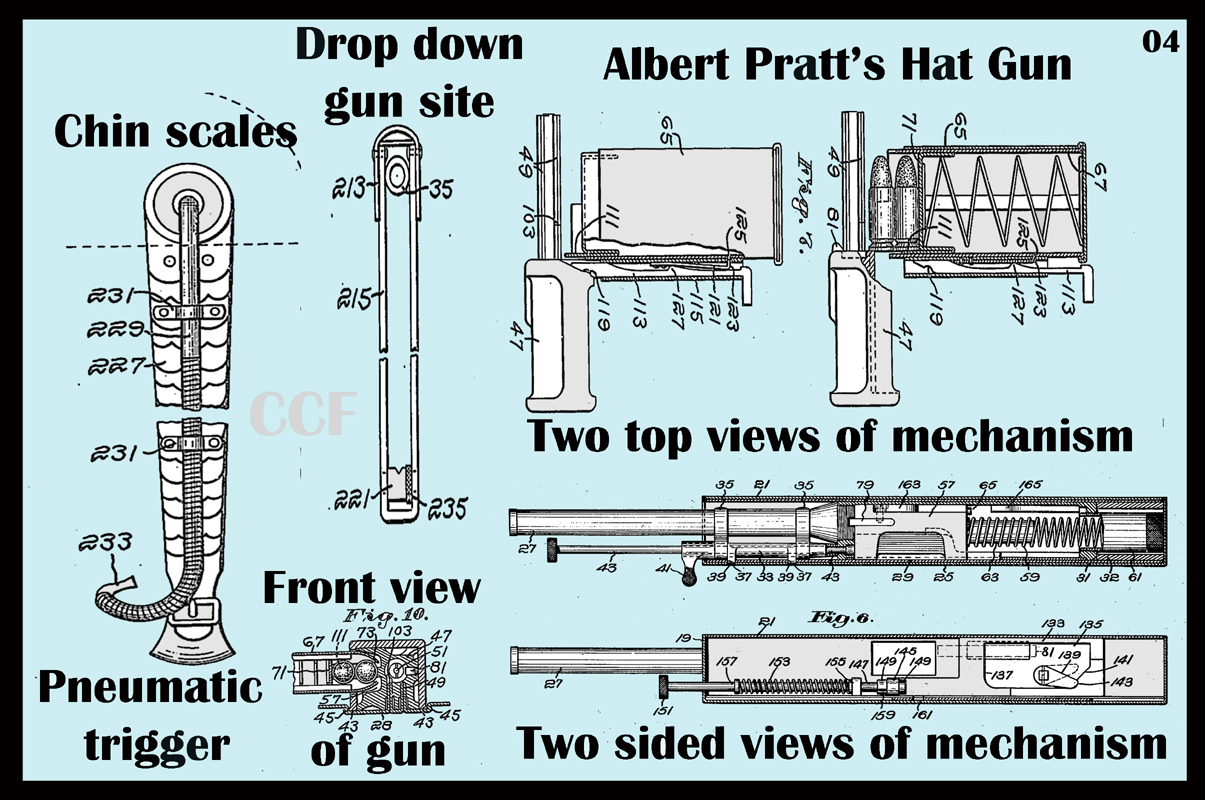
The hat is both a sun helmet as well as an armored gun port with a fixed handgun-sized semiautomatic pistol ensconced in the crown.  What appears to be a cannon barrel protruding in the hat in the illustration is in fact a semi shroud over the gun barrel itself.  The bottom portion of the barrel shroud is open.  The handy hat also has a generous bill fore and aft, which is not a bad thing in itself, shedding sun and rain.  The chinstrap is a pretty conventional set of buckled armored scales often seen on metal cavalry helmets of the 19th century.  A secure chin strap also necessary when firing the gun to keep the hat from flying backwards off the head.
Alongside the left chin scales is the trigger for the gun.  It a pneumatic tube, which can fire the gun with a simple puff of air. The pneumatic trigger to fire the gun was activated by blowing into a rubber tube possibly takes some inspiration from the pneumatic squeeze bulbs used to operate cameras, if so it’s on solid historical ground.  This allows the gun to be fired hands-free, which is a salient point in the patent text.  Aiming the hat gun is performed by simply turning the head and looking at the target.  For pinpoint accuracy a flip down sight is included which is housed inside the barrel shroud when not needed.  Who could ask for more convenience a century ago?  Before weapons computers, there was the brain!  You need only look, puff and fire.  The auto pistol loads a new round into the chamber and you are ready for action.

Pratt also patented the special gun that resides in the hat.  It’s basically an automatic pistol with a lateral magazine.  I’m not sure what happens to the hot brass extracted from the gun, but I hope it doesn’t fall down the collar of the intrepid hatketeer (musketeer) as he might be christened.  That clever gun is has patent number US 1323609 A, filed on 15 May 1916 but not granted until 2 Dec 1919, well after the war was over.  Ah well, it’s our loss.

The gun can be quickly charged by pressing a rod just beneath the barrel and easily accessible to the shooter’s finger since the shroud does not enclose the bottom of the barrel.  With practice cocking the gun can be accomplished with ease.  The gun’s safety is as simple as just tucking the pneumatic tube up into the helmet out of the way of errant sneezes.  The gun takes box magazines, which can be exchanged by doffing the hat, opening the top and quickly inserting a fresh magazine.  It appears that the gun might use a standard caliber, such as .32 automatic or possibly 9mm Kurtz, as the patent does not specify a preferred loading.  Certainly nothing larger than those would function well in a gun perched on the top of the head.  Of interest is the fact that the forward bill of the hat functions also as a blast shield from the gun’s discharge.  It’s a useful point. 

The gun can be removed from its bed on the lower section for cleaning or service quickly by rotating a toggle that lies quite near the charging handle.  I don’t think the gun was ever tried out nor has a patent model ever surfaced.  It’s a shame, because the thing would make an amusing Youtube video. 

The top of the hat functions as an armored helmet, which was just beginning to coming into vogue in the trenches of WWI due to shrapnel injuries.  The top of the hat can be removed by pressing spring held latches, which release that section.   The upper metal portion also has the handy feature of being used as a cooking pot as per the patent description.  The handy spike can be struck into the ground to hold the pan above a fire and the barrel shroud makes a handle.  The gun mechanism itself would be left behind and would remain in the bottom half of the hat and did not partake of the stew.  In fact, in a cooking emergency, the bottom of the hat, with the gun could remain on the head and fired at an enemy without interrupting your cooking!

Back to that fancy spike on top of the hat, which is type that graced the famous pickelhaubes of the Germans for decades.  But keep in mind that Teutonic spike also had appeared on the apex of American military hats as well.[4]  In fact the shape of Mr. Pratt’s hat is fairly close in outline to British military pith helmets such as the Bengal Lancer pattern, which on occasion could sport a spike as well.  You might take a look at my previous post on pith helmets if you have an interest on their history.  http://coastconfan.blogspot.com/2012/06/pith-helmets-sun-helmets-and-sola.html 

In considering Mr. Pratt’s Gun Hat, I don’t think much of having an army of hat gunners who point their weapons at the person they are looking at.  Imagine in formation: “Fall in, dress right dress, atten-shun .. eh .. eyes right, no sneezing in the ranks”!  Yes it could get quite dicey in some situations.  I think I’ll leave the hat gun for another war and another time.  Although they might have been useful for a bicycle corps, which at one time had a vogue among the military, especially in Europe. 

I hope you enjoyed this article as much as I had reading and researching about Mr. Pratt’s Hat Gun.  I added some cleaned up and modified patent drawings to illustrate some of the operating points of the hat and the gun.  Hopefully it should be clear up any questions the reader may have. If you know if there was a patent model produced or you know where the model is located, let me know and I’ll add that information to the blog entry. 

                   CoastConFan

Footnotes
  [1] The hat gun is mentioned in Firearms Curiosa, 1955, page 260, by Lewis Winant, published by Bonanza Books, NY.  The book is still reasonably priced from used book dealers. 

  [2] Patent number US 1191460 A   

  [3] Also not among them was the Wright Brother’s patent for safely controlling aircraft with ailerons.  The government didn’t want to pay them anything, so war-bound US aircraft were shipped up to Canada and the US patented bits were added there, prior to shipment to the front.  Military authorities also were not much interested in the Lewis Gun (due to politics), which was invented by US Army Colonel Isaac Newton Lewis in 1911, based on previous work by Samuel Maclean.  But the Brits loved it and it became one of the practical first man-portable machine guns.  It was used from WWI through WWII and years beyond.  The US did make a few on their own, but seemed largely disinterested after the Browning Automatic Rifle came out. 

  [4] American sun helmet Models 1880/1887/1889 and the 1902 sun helmet most of which had optional spike   http://www.nyc-techwriters.com/militaria/american_helmets1.htm

Links of Interest 
25th Infantry Bicycle Corps was an African-American military unit at the end of the Victorian era.  http://www.historynet.com/us-armys-25th-infantry-bicycle-corps-wheels-of-war.htm


The Wright Brother’s aircraft patent problems https://en.wikipedia.org/wiki/Wright_brothers_patent_war


Friday, October 28, 2016

Newcastle Forgotten Fantasy Library


I recently ran across the image of an old paperback I had back in the late ‘70s and it brought back a flood of memories.  It was the same edition I had owned of The Glittering Plain from the Newcastle Forgotten Fantasy Library series, which pretty much took over the field when the Ballentine Adult Fantasy series petered out.  The crappy blue monocolor cover and the hippy-dippy “mod” font on the inset was unmistakable. .This got me googling around the internet to unearth some information about the long-gone Newcastle Forgotten Fantasy Library series of books.  I hadn’t thought about them for decades. Those old style covers eventually were phased out for full color covers with original art with later issues. 

The creators of the Newcastle Forgotten Fantasy Library series, Douglas Menville and Robert Reginald, were no newbies to the fantasy genre or to publishing.  They previously had produced the magazine, Forgotten Fantasy from October 1970 to June 1971, running to only five issues of reprints of fantasy works.  I seem to recall seeing some copies lying about years later at used book shops, but I never picked them up, to my loss.  Little did I know, but the mod font of Forgotten Fantasy inset on the covers of the NFFL series was from the previous magazine, Forgotten Fantasy.  It only took thirty something years to clear up the mystery for me!  The late sixties and throughout the seventies were a rich time for new stories, revivals of old stories and for the world of gaming as we know it.
You’ll see some familiar faces with the NFFL series such as William Morris, Lord Dunsany and lots of H Rider Haggard and even an appearance of Bram Stoker.  Many of these authors had previously appeared in the Ballentine Adult Fantasy[1] series, although those stories were not repeated in the NFFL series.  More importantly you will find some authors not commonly mentioned in the past fifty years such as Leslie Barringer author of the hard to find Neustrian Cycle.  David Lindsay is there, but he’s not the modern American author, but the Englishman who wrote A Voyage to Acturus (1920), which appeared in a precursor volume of the Ballentine Adult Fantasy Series in 1968.
As a warning to some of the younger readers of this blog, the Newcastle Forgotten Fantasy Library series is a collection of antique books that are primarily Anglophile or Eurocentric in scope.  They were reprinted in the 1970s, much like the earlier Ballentine Adult Fantasy series and should be treated as a snapshot of that period.  Many of the books of these series were originally published a century or more ago, so they may not conform to the present state of fantasy writing, which is just as well, as fantasy is all about going out of the box and exploring “what ifs”.  When we lose our ability to dream and to put those ideas out in public we lose a large part of ourselves.  When we lose the possibility of publishing those dreams or being able to find them at bookstores or on line, we are in a dystopia.

One may ask, why such old tales are important now?  Here thirty five years later, well after the Newcastle Forgotten Fantasy Library ended its run and the original stories are sixty to a hundred fifty years old, with its books consigned to private libraries and to quiet bookshops, these authors have something to say to us about times past and about how people thought and read.  Really, they are not fundamentally different from us nor we from the author of Gilgamesh. 

I’m not here to create new or anoint exiting cannon, just to give new readers some ideas outside of the (present) box and let some older readers go down memory lane for a bit with these familiar works.  There’s recently been a lot of fuss about Appendix N [2] books and the like, as well as other “must read” or “must not read” lists.  There are attempts to control the narrative of Fantasy in the present as well as quelling books from the past.  Let’s keep our intellectual freedom open and away from self-appointed gatekeepers who think that they are the only ones who know what should be in print or on the net.  The other side of this problem is that there are those who think that the Fantasy genre is static, like a fly in amber and only their approved cannon is of consequence.  Both sides are wrong. 

Many of these books are out of copyright and available for free on line through such sites as Project Gutenberg or its sister down under Project Gutenberg Australia, or at the Internet Archive.org as well as through other electronic means. I found nearly all of them online in a variety of e-formats, including audio, and for free.  Did I mention free?  Additionally, some of these titles can be found as physical books at on-line book sites and at some book shops, used and for fairly reasonable prices.  Call me old fashioned, but nothing really takes the place of holding a real book in your hands. 


I have listed these works in order of their printing in the NFFL series, with the title and author linked to a page.  You can easily explore around and learn a bit about these books and their authors.
The Glittering Plain (1891) by William Morris, #1 NFFL, pub Sept 1973

The Saga of Eric Brighteyes (1890) by H. Rider Haggard, #2 NFFL, pub Mar 1974

The Food of Death:  Fifty-One Tales, (1915) by Lord Dunsany, #3 NFFL, pub Sept 1974

The Haunted Woman (1921) by David Lindsay, #4 NFFL, pub Mar 1975

Aladore (1914) by Sir Henry Newbolt, #5 NFFL, pub Sep 1975

She and Allan (1921) by H Rider Haggard, #6 NFFL, pub Sep 1975

Gerfalcon (1927) by Leslie Barringer, first book of the Neustrian Cycle, #7 NFFL, pub Mar 1976

Golden Wings and Other Stories (1856) by William Morris, #8 NFFL, pub Mar 1976

Joris of the Rock (1928) by Leslie Barringer, the second book of the Neustrian Cycle, #9 NFFL, pub Sep 1976

Heart of the World  (1895) by H Rider Haggard, #10 NFFL, pub Sep 1976


Child Christopher and Goldilind the Fair (1895) by William Morris, #12 NFFL, pub Apr 1977

Shy Leopardess (1948) by Leslie Barringer, the last book of the Neustrian Cycle, #13 NFFL, pub Oct 1977

Ayesha:  the Return of She (1905) by H Rider Haggard, #14 NFFL, pub Oct 1977

The Fates of the Princes of Dyfed (1914) by Kenneth Morris, #15 NFFL, pub Apr 1978

The House of the Wolfings (1889) by William Morris, #16 NFFL, pub Apr 1978

Under the Sunset (1881) by Bram Stoker, #17 NFFL, pub Oct 1978

Alan Quatermain (1887) by H Rider Haggard, #18 NFFL, pub Oct 1978

The Roots of the Mountains (1889) by William Morris #19 NFFL, pub Apr 1979

Nada the Lily (1892) by H Rider Haggard, #20 NFFL, pub Apr 1979

Jaufry the Knight and the Fair Brunissende (1856) trans by Alfred Elwes #21, pub Oct 1979

The Spirit of Bambatse (1906) by H Rider Haggard, #22 NFFL, Oct 1979 also titled Benith elsewhere

When Birds Fly South (1945) by Standton A Coblentz, #23 NFFL pub, Apr 1980

Alan’s Wife [and other tales] (1889) by H Rider Haggard, #24 NFFL pub, Oct 1980

I’ve enjoyed doing a bit of research on the Newcastle Forgotten Fantasy Library and find that I had owned and had read about half of the books on the list, several from the NFFL, which means I have a dozen more books to read! 
In some cases there are no simple links to the titles available.  I ask the readers to please help and add the articles to Wikipedia if they have read the books.  When you do so, let me know and I’ll update this list with a link.

Keep on reading …                 CoastConFan

Footnotes 
[1]  I’ve written previously about some of the books from the Ballentine Adult Fantasy series books in other posts on my blog, eventually I’ll actually produce a post about the BAF.

[2]  The introduction and book list to Appendix N of the AD&D Dungeon Master’s Guide (1979) by Earnest Gary Gygax, p 224 says it well: http://www.digital-eel.com/blog/ADnD_reading_list.htm

Additional Links of interest

Leslie Barringer’s three Neustrian Cycle books might still be in copyright, if so, they are available as pay e-books online.  
A great site with some of the illustrators for H Rider Haggard’s books  http://www.visualhaggard.org/illustrators


Now a little exit music please – https://youtu.be/zqfFrCUrEbY .    My thanks to The Zimmers for their 2007 cover of The Who’s My Generation, which was first released in 1965 in the UK, so it seems appropriate.

Saturday, October 1, 2016

Ernest Bramah, Kai Lung, Li Kung and A Case for Mandarin English


My first exposure to the works of Ernest Bramah Smith, under the pen name  Ernest Bramah, was from Lin Carter’s Ballentine Adult Fantasy Series, which introduced young readers (and not a few older ones) to fantasy works both important and rare, many of which had been out of print for years.  This was especially important in those days before the internet or for those without a major metropolitan library available.   Although the series ran from 1969 to 1974, it placed important volumes in the hands of readers who might never have previously encountered them.
name was

The series had two Ernest Bramah books in its listings, Kai Lung’s Golden Hours (number 45), which was reprinted in 1972 for the series and Kai Lung Unrolls His Mat (number 64) in 1974.  Actually I read the second one first and turned up the former at a SF convention in the latter ‘70s.   Eventually, I had nearly all the BAF books, including the precursors and leftovers, carefully collected over many years at used book shops, conventions and flea markets.  Alas, they went with The Storm, along many hundred of their siblings, but such is the way of things.   But now I have many of them in electronic format.

Recently I turned up a book that made me suspect that Bramah’s character Kai Lung may be a humorous nod to a real historical figure in Chinese history:  Li Kung-lin [a] , was a Sung  philosopher and painter of the 11th century who is considered to be an important scholar of Confucius.  The transliteration of the name stuck me as too much of a coincidence as Ernest Bramah Smith was supposedly quite well read.  I have a strong feeling that Li Kung was indeed the inspiration for Bramah’s literary character Kai Lung, although I have no proof.  Now this possibility might be known and documented some deep Ernest Bramah scholars, but that is unknown to me.  I’d certainly like to see somebody take this up and either expose my ignorance or agree with my hypothesis.

The book in question in this bit of serendipity that set this post in motion was a volume called Li Kung-lin’s Classic of Filial Piety[b] , which was published in translation (1993) by the Metropolitan Museum of Art, authored by Richard M. Barnhart, Gonglin Li, and Robert E. Harrist.  The Met site had it available for free download and you know me and free ebooks. Many thanks to the Met for their e-generosity.  The link to download both this fine Met book and English translations of Li Kung’s original work for those of you who are interested is available here.  http://www.metmuseum.org/art/metpublications/li_kung_lins_classic_of_filial_piety 

Translations of the text here 

Bramah’s technique of poking fun at British institutions by pretending they are actually translated from Chinese and written in a stilted “English translation” style of formal language which is jokingly called Mandarin English for its formal stiffness and yet subtlety of meaning.  In addition to facetiously flowery language, circumlocution, and obscure descriptions of common western ideas, he also used joking proverbs and aphorisms, many of which are recognizable distortions of English sayings.  For examples of these you can go to the Wikipedia page for Ernest Bramah page in the “writing career” section  https://en.wikipedia.org/wiki/Ernest_Bramah

This site gives twenty five Kai Lung quotes to amuse the reader  http://www.azquotes.com/author/28464-Ernest_Bramah as does Wikiquote  https://en.wikiquote.org/wiki/Ernest_Bramah .  Here is a pretty good essay about Ernest Bramah that also explains Mandarin English  http://www.ernestbramah.com/gaspar.htm .

An origin of this style of writing in English literature can probably be referenced to Tobias Smollett’s satirical work The History and Adventure of an Atom, (1749) where Smollett makes fun of England and English figures by pretending it’s actually Japan. Bramah’s Kai Lung stories does pretty much the same, but more gently and with a good deal more geniality.  The History and Adventure of an Atom is an amusing proto-science fiction work in itself, as communication with an atom is not possible nor are they sapient, at least as far as we know.  The link for downloading is in the link section.

Another possible source (and closer to the experience of the average person) is Gilbert and Sullivan’s comic opera The Mikado; or, The Town of Titipu, which Bramah was surely familiar since the opera has run on stages from its debut in 1885 to the present day.  Nobody watching or reading the operetta could fail to notice that the characters of The Mikado were actually based British civil servants. 

Another source is Jonathan Swift’s satire is probably better known to today’s readers with his famous Gulliver’s Travels.  Swift’s Gulliver’s Travels (1726) has the Struldbrugs of Luggnagg near Japan, but this is probably reaching a bit in connecting him to Brama.  What can’t be discounted, however is that Bramah was familiar with Swift’s satire.

To bring this discussion a bit more up to date, Brama’s humorous Mandarin English style is not what is now is being called orientalization by any means.  In fact, he was poking fun at Britain and its institutions, not at Chinese people or the their culture during the imperial period.   Nor was Bramah doing so it in the sense of Edward Said’s definition found in his book Orientalism (1978), which is making the rounds again in fashionable salons who have just discovered the book as it nears its fourth decade in print. 

Lin Carter, the architect of Ballentine Adult Fantasy Series said in his book Discoveries in Fantasy (1974)  Ernest Bramah’s China, then, is a fantastic bogus China of convention, not the real historical thing at all.  He wrote in a prose so perfectly conceived that it become a miracle of style.  As Hilarie Belloc once observed, the sly humor and philosophy of Bramah’s stories is a trick he achieved by pretending t adapt the flavor of Chinese literary conventions into the English”.  Kai Lung had several fans over the years along with Hillary Belloc and surprisingly Jorg Luis Borges was also a fan.

There are two Kai Lung books have been printed, both containing stories not previously available.  One is a rare volume in an edition of 250 published in 1974, that escaped my attention for many years due to its rarity, which was called Kai Lung Six, which is a group of stories originally published in Punch and not seen the light of day since then.  Those stories and a number of never-published Kai Lung stories appear in the much more accessible and more recent  book, Kai Lung Raises His Voice (2010) by Durrant Pub.  I haven’t yet gotten a copy, but it’s on my list.

At this point, I’d like to point out another work by Bramah that showcases his style is, The Mirror of Kong Ho (1905). While not part of the Kai Lung series, its in the mood of his style with a series of short stories in the form of letters from a Chinese gentleman discussing the eccentricities of the barbarians living in England.  It really holds up a mirror to the west at a time where westerners took themselves and their superiority for granted. 

Personally, Ernest Bramah Smith very private man who gave no details of his life during his time on this planet.   The only recent biography of him is by Aubrey Wilson, The Search for Ernest Bramah (Creighton and Read 2007).  I didn’t use this book as a source simply because I didn’t have a copy available.  It’s possible the Kai Lung/Li Kung story is explained there.   The Wikipedia article on him and the below essay in links is about all that’s easily accessible on the web as far as his personal life.  But what’s important is not the man, but the works and what them mean to us, both when they were originally written, beginning about a century ago and what they mean to us today.

Hopefully, this bit of esoteric diversion hasn’t bored you too much and has given you a few books to consider reading this fall.  I’m no scholar but have been a reader and autodidact for half a century and not a few books have both fallen into my grasp as well as escaped my attention.  In any case, all but a few of the mentioned books are free downloads, so it won’t cost you anything to enjoy them. 

                         CoastConFan

The text to this post is copyright William Murphy 2016 – ‘cause I created this.  The images belong to their creators and quotes of others are attributed.  If I missed anything, let me know.   Feel free to link to this post or quote me. 

Footnotes
[a]   “The figure painter Li Kung-lin, who lived in China from about 1041 to 1106, was the leading exponent of the Northern Sung scholar-official aesthetic. One hundred seven of his works were recorded in the great government catalogue of the imperial collection of paintings a few years after his death. Sadly, today only three of his works still exist. The hand scroll of the Hsiao-ching, or Classic of Filial Piety, a classic of the orthodox canon of Confucianism, is one of those three. It is among the preeminent monuments of Chinese cultural and art history”.  Richard M. Barnhart, Prof  History of Art at Yale

Additionally, for those of you who have a thirst for knowledge, the role of filial piety within Confucian thought and society is discussed in Fung Yu-lan’s, A History of Chinese Philosophy, trans. Dirk Bodde, 2 vols.  Also I found Li Kung-lins’s name in A Source Book in Chinese Philosophy, pg 704.

[b]  “A slight volume composed of eighteen chapters, the Classic of Filial Piety takes the form of a dialogue between Confucius and his disciple Tseng-tzu on the meaning and application of filial piety in the affairs of the individual and of the state. The text dates to the period between 350 and 200 B.C., long after either Confucius or his immediate disciples lived, but its subject, the governing of relationships among men and the rules of conduct by which society is made secure, was for centuries before and for centuries to come the keystone of Chinese society.
Before Li's time, the art of painting had been a public and imperial art, conveying the images, ideas, values, and propaganda of the imperial court, the powerful hereditary families, and the great temples. In the eleventh century, under the inspiration of Li Kung-lin and a few others, painting was transformed into a formal mode of expression, which, like poetry, could serve to convey the mind of the artist as well as the emblems of those who controlled his life. For Li, art was a tool, a moral vehicle that allowed him to set out his views of the institutions, ideas, and conflicts of his time.”  Richard M. Barnhart, Prof History of Art at Yale


Links of Interest – in no particular order, because I’m lazy
The Ernest  Bramah site http://www.ernestbramah.com/

Wikipedia article on The Wallet of Kai Lung https://en.wikipedia.org/wiki/The_Wallet_of_Kai_Lung 

Download a digital copy of some of Bramah’s works
Kai Lung series
The Wallet of Ki Lung (1900) https://www.gutenberg.org/ebooks/1076
Kai Lung’s Golden Hours (1922)  https://www.gutenberg.org/ebooks/1267
Kai Lung Unrolls His Mat (1928)  http://gutenberg.net.au/ebooks13/1302251h.html
The Moon of Much Gladness (1932)  Unavailable for free in digital format for now
Kai Lung Beneath the Mulberry Tree (1940)  Unavailable for free in digital format for now
Kai Lung Six (1974)  Unavailable for free in digital format
Kai Lung Raises His Voice (2010) Unavailable for free in digital format

The Mirror of Kong Ho (1905) While not part of the Kai Lung series it sets the pace for his style with a series of short stories in the form of letters from a Chinese gentleman discussing the eccentricities of the barbarians living in England.  It really holds up an amusing mirror to the west.   https://www.gutenberg.org/ebooks/1077

And some other works by Bramah that were also popular in his time
Four Max Carrados Detective Stories  https://www.gutenberg.org/ebooks/12932
The Secret of the League:  The Story of a Social War  https://www.gutenberg.org/ebooks/34522

More stuff
An essay about Ernest Bramah  http://www.ernestbramah.com/gaspar.htm

The most recent biographical source is: Aubrey Wilson, The Search for Ernest Bramah (Creighton and Read 2007), which I have not read and so consequently have not used in this article.

Ernest  Bramah site http://www.ernestbramah.com/

Download Smollett’s Adventure of an Atom (1749)

Download Johnathan Swift’s Gulliver’s Travels in digitial formats

What started this article in the first place was the discovery of this book (which you can download for free BTW) and of the existence of Li Kung, at least for me  http://www.metmuseum.org/art/metpublications/li_kung_lins_classic_of_filial_piety 
By Richard M. Barnhart, Gonglin Li, Robert E. Harrist

Saturday, August 20, 2016

Happy Birthday H. P. Lovecraft


Today is 20th of August and H P Lovecraft’s birthday.  He was born in Providence, RI on 20 August 1890 and died 15 March 1937.  His life was short but his writings are a major influence on writers, readers, and fans for decades.  Here’s a card.
                   CoastConFan

Here’s a link to the complete works of HPL via The Arkham Archivist in several e-formats http://arkhamarchivist.com/free-complete-lovecraft-ebook-nook-kindle/